 © NVIDIA
Then vs. Now · 24 Nov 2026 · 5 min read
Is the DGX Spark the Apple-1 of the AI generation?
One was soldered by hand in a garage and sold through a single shop. The other went on sale at Micro Center. The comparison is still worth making, as long as you make it honestly.
Every collecting field has one object that stands for the moment everything changed. For personal computing it is the Apple-1. Two hundred boards, according to the registry that tracks them, built in two batches in 1976. Ninety-four are accounted for today, seventy of them in working order.
The question collectors of the AI era keep asking is which object will play that part for them. The most frequently nominated candidate is a small gold box that NVIDIA started selling on 15 October 2025: the DGX Spark.
It is a good question. It deserves a better answer than yes.
What the Apple-1 actually is
The Apple-1 matters for a reason that has nothing to do with how well it worked. It marks the point at which a computer became a thing a single person could own. Before it, computing was institutional. After it, it was personal. The object sits exactly on the line.
It is also extremely scarce, and scarce in a documented way. The Apple-1 Registry lists every known board by number and nickname, records which are verified, which still run, and what each has sold for. That is why the market can function. In the past three years, ordinary working examples have sold for roughly $315,000 to $575,000 including buyer's premium. Boards with exceptional stories go far higher: $945,000 at Christie's in 2024 for the unit from Steve Jobs's office, $1,148,200 at Bonhams in October 2026, and $2,750,000 at RR Auction in January 2026 for the board known as the Celebration, which RR Auction sold as a pre-production prototype.
Note what tops that list. Not an ordinary production machine, but a board sold as a prototype. The Apple-1 Registry records an expert view that it was probably built after the first run, so the claim is disputed; the market paid for it anyway.
What the DGX Spark actually is
Until the Spark, the letters DGX meant a rack-mounted system for a data centre. The first of them, the DGX-1, was announced in April 2016 with a list price reported at $129,000 and a power draw of 3,200 watts.
The Spark carries the same name on a desktop machine. NVIDIA says it delivers up to a petaflop of AI performance and can run models of up to 200 billion parameters locally, on 128GB of unified memory, from a wall socket. Press reports put the launch price at $3,999. For the first time, a credible amount of AI compute became a thing a single person could own.
That is the parallel, and it is a real one. Institutional to personal. The object on the line.
The delivery
NVIDIA understands this better than anyone, because it has done it before.
In August 2016, Jensen Huang carried the first DGX-1 into OpenAI's office in San Francisco and wrote on the chassis in marker: "To Elon and the OpenAI Team! To the future of computing and humanity. I present you the world's first DGX-1!" There is a photograph of him with Elon Musk and the machine. Fortune reported that NVIDIA described it as a donation.
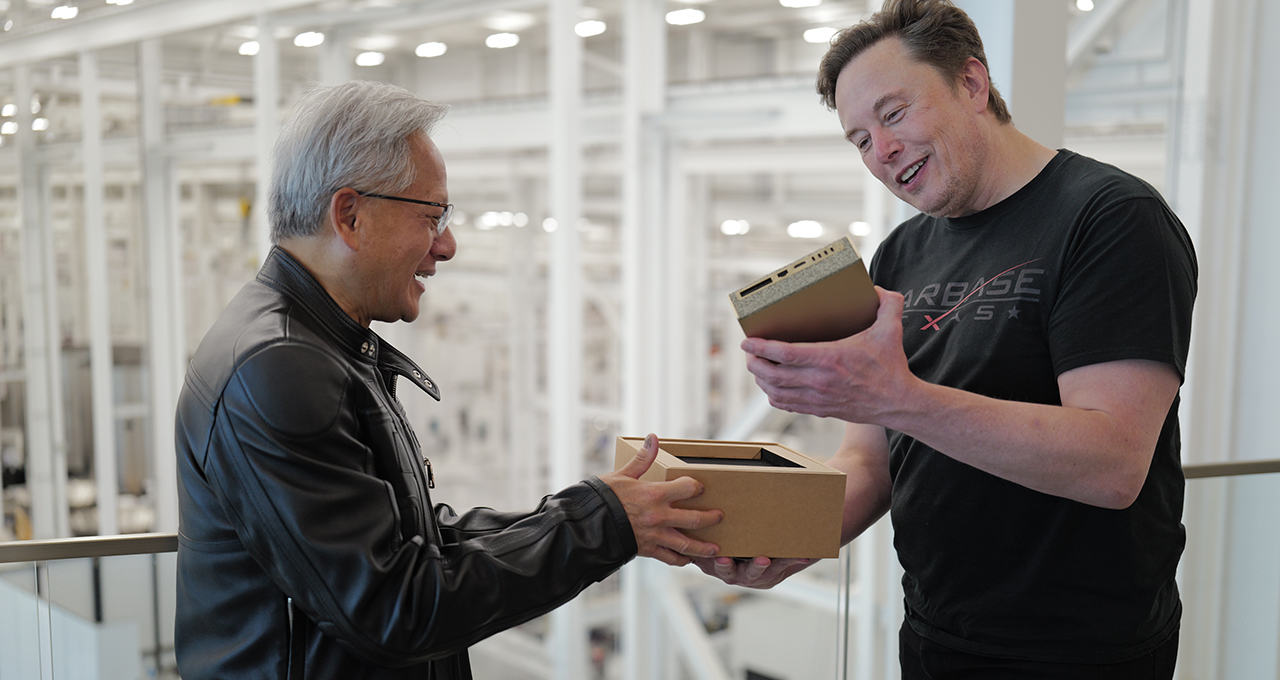
In October 2025, before the Spark went on general sale, Huang did it again. He handed one to Musk at SpaceX's Starbase in Texas and another to Sam Altman at OpenAI. NVIDIA's own account of the day makes the reference to 2016 explicit.
A company restaging its own founding scene is unusual. It tells you the company already thinks of the 2016 machine as a historical object, and wants the 2025 one to inherit the status.
Where the comparison breaks
It breaks on numbers, and it breaks completely.
About two hundred Apple-1s were made, by hand, and sold largely through one shop. The DGX Spark is a mass-market product sold through NVIDIA and major retailers. The same hardware platform is sold under seven other brand names. NVIDIA has published no production figure, which in practice means "a lot".
It also breaks on time. Nobody who bought an Apple-1 in 1976 was thinking about 2026. Plenty of people buying a Spark today are thinking about 2056, and an object that everybody saves is an object that never becomes rare. A year after launch, reports put the 128GB model at $6,950 following two price increases, and a 64GB version was announced for sale through partners only. That is the behaviour of a product line, not of a relic.
So what is the Apple-1 of AI?
Go back to that auction list. The record is held by a board sold as a prototype. Close behind it, in the same January 2026 sale, came a cheque: Apple's first, for $500, which made $2,409,886.
The lesson of the Apple market is that the highest prices do not go to the product. They go to the objects closest to the founding moment: the prototype, the first cheque, the contract, the unit from the founder's desk.
On that reading, the Apple-1 of the AI generation already exists and is not for sale. It is the inscribed DGX-1 that Huang delivered to OpenAI in 2016. It is unique, it is signed, it is photographed, and it sits at the start of the story. Nobody outside OpenAI appears to know where it is today. We could find no record of a sale, a loan or a museum accession.
The Spark is something else: the first machine in that lineage that ordinary people could buy. If it has a historical parallel at Apple, it is less the Apple-1 than the Apple II, the one that actually went into homes.
If you want one anyway
That is not a reason to ignore it. It is a reason to be specific.
An NVIDIA-branded unit, not a partner version. Bought in the first weeks, with an invoice that proves it. The original 128GB configuration. Everything that came in the box, kept together. And if one of the units Huang delivered by hand in October 2025 ever comes to market with its paperwork, that is the one to watch: it would be the first time a piece of the delivery ritual itself changed hands.
Everything else is a very good computer. There is nothing wrong with owning a very good computer. It is just a different thing from owning the garage.
Sources
- Apple-1 Registry: list of all Apple-1 computers
- Apple-1 Registry: market and auction results
- NVIDIA Blog: DGX Spark early deliveries
- NVIDIA press release: DGX Spark arrives for the world's AI developers (13 Oct 2025)
- NVIDIA press release: NVIDIA launches world's first deep learning supercomputer (5 Apr 2016)
- Fortune: Elon Musk's OpenAI gets Nvidia supercomputer (15 Aug 2016)
- TweakTown: 64GB DGX Spark and price history (3 Oct 2026)
- RR Auction, lot 6003: Apple-1 prototype board, the 'Celebration' board