 © NVIDIA
The Hunt · 24 Nov 2026 · 4 min read
Where is the first NVIDIA supercomputer ever delivered to OpenAI?
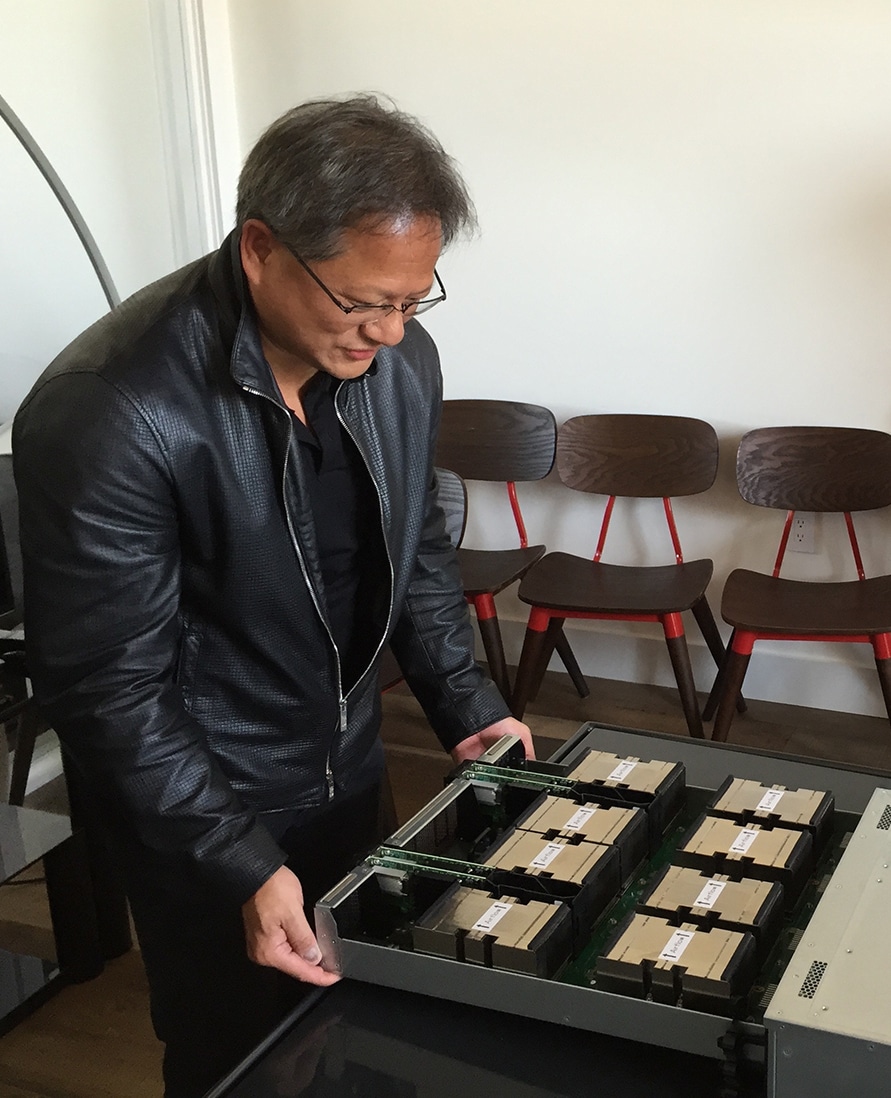
In August 2016 Jensen Huang carried a machine into a small San Francisco lab and wrote a dedication on the lid. It may be the most important object of the AI era. Nobody will say where it is.
In sport, the most valuable shirt is not the one a legend wore. It is the one he wore on the night. Collectors call it game-used, and they will pay many times more for it than for an identical shirt from the same season, because it was there.
Technology has very few objects that pass that test. This is the clearest one, and it is missing.
What happened
On 5 April 2016, at its GTC conference, NVIDIA announced the DGX-1 and called it "the world's first deep learning supercomputer": eight Tesla P100 graphics processors in a single 3U box, rated at up to 170 teraflops and drawing 3,200 watts. Contemporary coverage put the list price at $129,000.
That August, Jensen Huang delivered the first one himself. He carried it into the office of OpenAI, then a non-profit research lab less than a year old, in San Francisco. Fortune reported it on 15 August as having happened the week before, and said NVIDIA described the machine as a donation.
Before handing it over, Huang wrote on the chassis in marker:
To Elon and the OpenAI Team! To the future of computing and humanity. I present you the world's first DGX-1!
NVIDIA photographed the moment. The picture shows Huang and Elon Musk, then one of OpenAI's co-founders, standing beside the machine.
Six years later, OpenAI released ChatGPT.
Why this one, and not any DGX-1
NVIDIA sold DGX-1s to universities, companies and research labs. An ordinary one is a heavy, power-hungry server with a significant place in the history of AI infrastructure, and in time it will be an interesting thing to own.
This one is different in exactly the way a game-used jersey is different. It is the first unit. It carries a dedication in the founder's hand. It is documented by a photograph, by the company's own retelling, and by the press at the time. And it went to the organisation that would turn deep learning into a household product.
NVIDIA clearly knows what it has created. In April 2024 Huang personally delivered the first DGX H200 to OpenAI. In October 2025 he handed one of the first DGX Spark desktops to Sam Altman, and another to Musk at Starbase, and NVIDIA's own account of that day refers back to 2016 in so many words. A company does not keep restaging a scene unless it believes the original matters.
The comparison with Apple
The Apple market shows what objects like this become.
In January 2026 the Celebration board, a pre-production Apple-1 used to check the design before the first order was built, sold at RR Auction for $2.75 million. In the same sale, Apple's first cheque, for $500 and signed by Jobs and Wozniak, made $2,409,886. Neither is the product. Both are the objects closest to the moment the company began.
The inscribed DGX-1 is that kind of object. It is the AI era's Check No. 1.
What we could not find
We looked for every trace of the machine after August 2016. We found none.
No published source gives its serial number. We found no record of a sale, no record of a loan, and no museum accession: not at the Computer History Museum, not at the Smithsonian. We do not know whether it is still at OpenAI, whether it was retired when the lab grew and moved, whether it still runs, or whether the marker inscription has survived years of handling.
That silence is itself informative. Our reading, and it is only a reading, is that a machine this well known would probably have surfaced if it had left OpenAI. The likeliest answer is the least exciting: it is still there, in an office, a store room or a data hall, its importance obvious to everyone and its location published by no one.
Why it matters that we find out
Objects like this are not lost dramatically. They are lost administratively: in an office move, a hardware refresh, a clear-out by someone who does not know which grey box is which. The DGX-1 was a working server, not a trophy, and working servers get replaced.
Most of the Apple objects that now sell for millions survived because someone happened to keep them, not because anyone set out to preserve them. The AI era can do better than luck.
What happens next
This is the first file in The Hunt, and it is open. We are asking OpenAI whether it still holds the machine and whether it is on display; asking NVIDIA whether it recorded the serial number; checking museum collections; and looking for photographs of OpenAI's offices in which the machine appears.
The full case file lists what is known, what is not, and the questions we most need answered. If you were in that office in 2016, or know where the machine went, that is where to start.
The DGX-1 is not for sale, and may never be. It belongs on this site anyway. A collector's first job is to know which objects matter. The second is to make sure they are still there.
Sources
- NVIDIA: NVIDIA launches world's first deep learning supercomputer (5 Apr 2016)
- Fortune: Elon Musk's OpenAI gets Nvidia supercomputer (15 Aug 2016)
- TOP500: NVIDIA delivers DGX-1 'supercomputer in a box' to OpenAI
- Fortune: Jensen Huang on delivering the first AI supercomputer (22 Feb 2024)
- Analytics India Magazine: Jensen Huang personally delivers first DGX H200 to OpenAI (25 Apr 2024)
- NVIDIA Blog: DGX Spark early deliveries
- RR Auction, lot 6003: Apple-1 prototype board, the 'Celebration' board