 Photo: RR Auction
Photograph © RR Auction. Original ↗
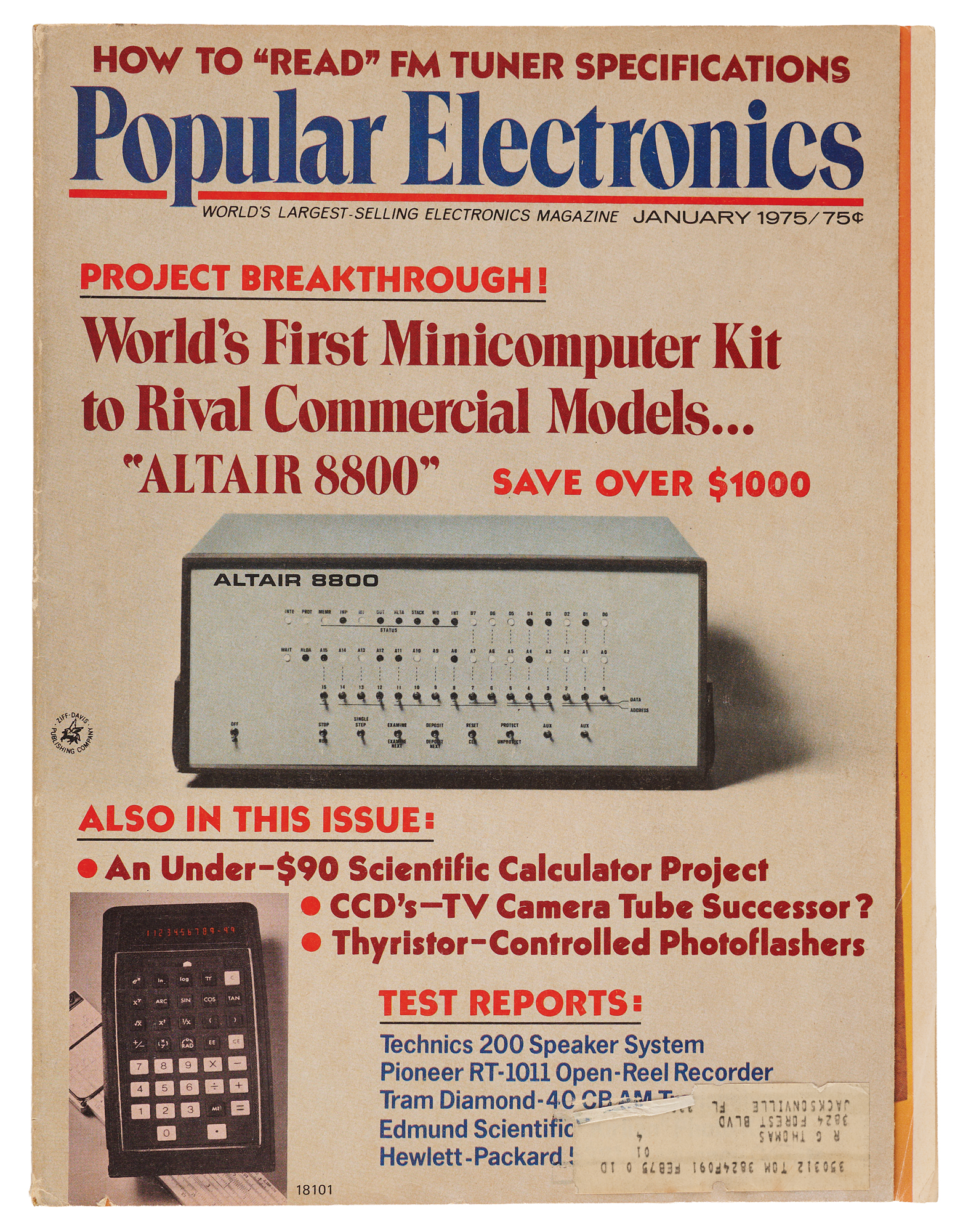
Popular Electronics, January 1975 (Altair 8800 cover)
The January 1975 issue that announced the Altair 8800 kit and set Bill Gates and Paul Allen to work. A plain newsstand copy, with an address label, open at RR Auction until 9 December 2026.
- Maker
- Popular Electronics (Ziff-Davis)
- Year
- 1975
- Category
- Tech History
$200 (1 bid)
Current bid · RR Auction (auction 755) · closes 09 Dec 2026
Relic Score
How we scoreA landmark issue, catalogued by RR and confirmed by the Computer History Museum. Copies trade often, but we hold no sale record.
The three questions we ask of every object
- Why is it rare?
- No. It was a newsstand magazine and copies survive in numbers, though nobody publishes a count. Condition and the absence of an address label matter; this copy has a label on the cover.
- What story does it tell?
- The issue whose cover put the MITS Altair 8800 kit in front of hobbyists. RR's lot description links it to the Homebrew Computer Club and to Paul Allen showing it to Bill Gates before Microsoft began.
- Why would someone want it in 2050?
- It is the printed starting gun of the personal computer, and the cheapest way to own a piece of that moment. In 2050 it will still be a magazine: its weight comes from what readers did with it.
The record
DocumentedAn original January 1975 issue of Popular Electronics (volume 7, number 1, 112 pages, 8.25 by 11 inches). The cover shows the Altair 8800 microcomputer, and RR quotes the cover line "Project Breakthrough! World's First Minicomputer Kit to Rival Commercial Models". A companion article by H. Edward Roberts and William Yates on pages 33 to 38 gives the machine's technical details, parts list and applications.
RR's description links the issue to the Homebrew Computer Club, which Steve Jobs and Steve Wozniak attended months later, and states that Paul Allen brought it to Bill Gates's Harvard dorm room before the founding of Microsoft. The Computer History Museum's record of the Altair confirms that Popular Electronics featured the kit in January 1975 and that it inspired Gates and Allen to write a BASIC interpreter.
RR grades the copy very good to fine, with some corner creasing and an address label on the front cover. It is lot 242 of RR Auction's sale 755, estimated at $500+. On 25 November 2026 the bid stood at $200 after one bid.
Why it matters
Editorial viewFew magazines can claim to have started an industry; this one has a fair case. The kit on its cover gave Microsoft its first product and gave the Homebrew Computer Club its first topic.
The object itself is common. Its interest lies in the story it carries and, for a collector, in condition: a subscriber copy with an address label is the usual survivor, not the best one.
Rarity
Not documentedNot documented. A mass-circulation magazine; no census of surviving copies exists.
What to look for
- 01The cover and the Roberts and Yates article on pages 33 to 38, complete and uncut.
- 02Address labels, which mark a subscriber copy and lower the condition.
- 03Spine and staple condition, and any loose pages.
- 04The February 1975 issue, which carried the second part of the article.
Where it stands
- RR Auction (auction 755) ↗
Very good to fine per the seller, with corner creasing and an address label on the front cover. Bid as shown on RR's category listing on 25 November 2026. Per RR, a first bid must be in by 6:00 PM Eastern on 9 December 2026; the 30-minute rule starts at 7:00 PM. RR charges a 25% buyer's premium.
$200 (1 bid)Current bid · est. $500+Closes 09 Dec 2026AvailableChecked 25 Nov 2026
Asking prices and stock are as observed on the date shown and change without notice. Future Relics does not sell these objects and currently earns no commission on these links.
What we could not confirm
The Gates and Allen anecdote is widely told; we cite it from RR and the Computer History Museum, not from a first-hand account. The bid will have moved since we checked.
Sources
- [1]RR Auction, lot 242: Altair 8800: Popular Electronics magazine from January 1975 (auction 755) · rrauction.com ↗
- [2]RR Auction: Fine Autographs and Artifacts Featuring Sports, Encapsulation and Animation, auction 755 (closes 9 December 2026) · rrauction.com ↗
- [3]Computer History Museum: MITS Altair 8800 (object 102621982) · computerhistory.org ↗
Record opened 25 Nov 2026 · Last verified 25 Nov 2026