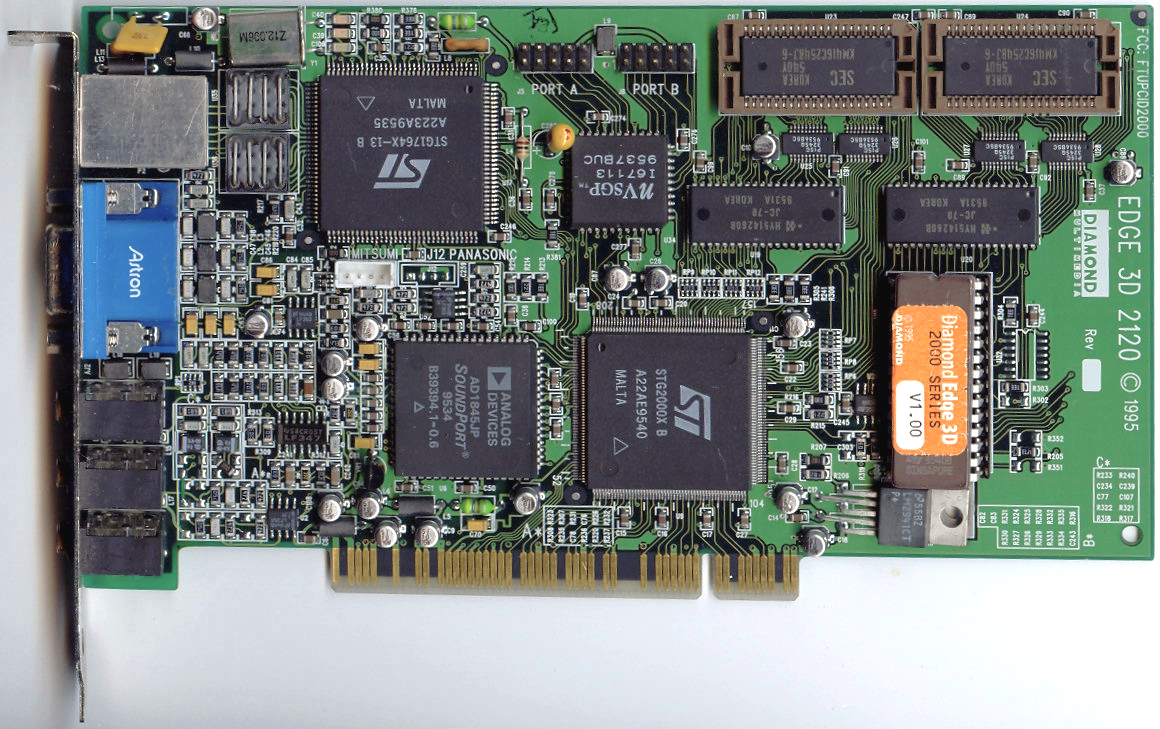
 © Swaaye / Wikimedia Commons, licence CC BY-SA 3.0
 © Hyins / Wikimedia Commons, public domain
NVIDIA × Diamond Multimedia · AI Hardware
NVIDIA NV1 (Diamond Edge 3D)
No public price
First edition· relic level 2 of 6We link out and take no commission.
NVIDIA's first product, and a failure: a 1995 multimedia card that bet on curved surfaces while the rest of the PC industry chose polygons. It is remembered because the company survived it.
Relic level
How close this object was to the moment history happened. The closer, the rarer it can only become.
- History makerIt was there when history happened.
- Founder's ownOwned or used by a defining founder.
- PrototypeA prototype, a first unit or a historic serial.
- SignedSigned, or a numbered limited edition.
- First editionA first generation, kept sealed or complete.This one
- Official merchOfficial merchandise, no proven rarity yet.
Why is it rare?+
Nobody can say. No sales figures were published and there is no register of surviving boards. It was a retail card and a failure, so boxed examples may be uncommon, but that is an inference and not a documented fact.
What story does it tell?+
NVIDIA's first product, from 1995: a card that bet on curved surfaces while the industry chose polygons. It matters because the company survived it.
Why would someone want it in 2050?+
Because it is the first object of the company at the centre of the AI era. A failed debut becomes a founding artefact when its maker goes on to matter, and NVIDIA did.
The full record+
The NV1 was NVIDIA's first product, rolled out in 1995. According to Jon Peddie's history of the chip, published by Electronic Design, the DRAM version, SGS-Thomson's STG2000, launched in May 1995 as a PCI add-in board, and Diamond Multimedia sold the card at retail as the Edge 3D.
It was a single-chip multimedia accelerator that combined 2D graphics, texture-mapped 3D, wavetable audio and a game-port interface, with roughly 250,000 transistors.
The NV1 rendered with quadratic texture mapping, not the polygons the rest of the PC industry adopted. Sega of America licensed NVIDIA to help bring Saturn and arcade titles to PCs equipped with the card.
Developers were slow to adopt the approach. Sega later dropped NVIDIA for its next console, and NVIDIA switched to the polygon designs that led to the RIVA 128 in 1997. Peddie's account gives no sales figures.
Every fact is sourced. Sources and uncertainties