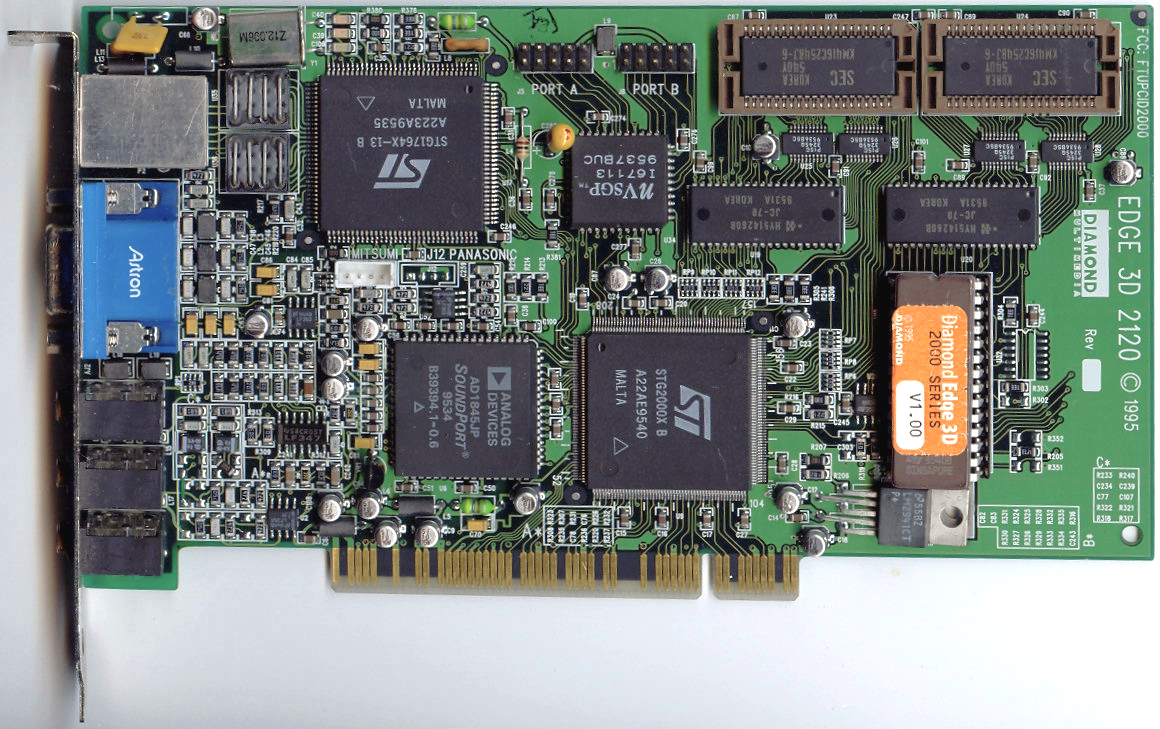
 Photo: Swaaye / Wikimedia Commons, licence CC BY-SA 3.0

Photograph © Swaaye / Wikimedia Commons, licence CC BY-SA 3.0. Original ↗
NVIDIA NV1 (Diamond Edge 3D)
NVIDIA's first product, and a failure: a 1995 multimedia card that bet on curved surfaces while the rest of the PC industry chose polygons. It is remembered because the company survived it.
- Year
- 1995
- Category
- AI Hardware
No public price
Value unproven
Relic Score
How we scoreThe first product of the company at the centre of the AI era, known here through one secondary history. No sale on record.
The three questions we ask of every object
- Why is it rare?
- Nobody can say. No sales figures were published and there is no register of surviving boards. It was a retail card and a failure, so boxed examples may be uncommon, but that is an inference and not a documented fact.
- What story does it tell?
- NVIDIA's first product, from 1995: a card that bet on curved surfaces while the industry chose polygons. It matters because the company survived it.
- Why would someone want it in 2050?
- Because it is the first object of the company at the centre of the AI era. A failed debut becomes a founding artefact when its maker goes on to matter, and NVIDIA did.
The record
DocumentedThe NV1 was NVIDIA's first product, rolled out in 1995. According to Jon Peddie's history of the chip, published by Electronic Design, the DRAM version, SGS-Thomson's STG2000, launched in May 1995 as a PCI add-in board, and Diamond Multimedia sold the card at retail as the Edge 3D.
It was a single-chip multimedia accelerator that combined 2D graphics, texture-mapped 3D, wavetable audio and a game-port interface, with roughly 250,000 transistors.
The NV1 rendered with quadratic texture mapping, not the polygons the rest of the PC industry adopted. Sega of America licensed NVIDIA to help bring Saturn and arcade titles to PCs equipped with the card.
Developers were slow to adopt the approach. Sega later dropped NVIDIA for its next console, and NVIDIA switched to the polygon designs that led to the RIVA 128 in 1997. Peddie's account gives no sales figures.
Why it matters
Editorial viewEvery company has a first object, and it is rarely the one it would choose to be remembered by. NVIDIA's was a card that tried to do graphics, sound and game controllers on one chip, in a rendering style nobody else followed.
The precedent it sets for today's objects is about failed first products. The NV1 is of interest now only because of what NVIDIA did afterwards. That is the test to apply to the first devices of today's AI hardware start-ups: a failed debut becomes a founding artefact when the company goes on to matter, and stays a curiosity when it does not.
Its limits are documentary. The account here rests on one secondary history. We have no sales figures, no retail price and no record of a card selling as a collectible.
Rarity
Not documentedNot published. Jon Peddie's history of the chip gives no sales figures, and no register of surviving boards was found.
Classification
- First Edition
EvidenceNVIDIA's first product, rolled out in 1995, per Jon Peddie Research in Electronic Design.
What to look for
- 01The Diamond Edge 3D retail board, ideally boxed. That is the form in which the NV1 reached shops.
- 02Which chip is on the board. SGS-Thomson's STG2000 was the DRAM version, launched in May 1995.
- 03Any software that came with it. The Sega licence, meant to bring Saturn and arcade titles to NV1 PCs, is the heart of the story, and discs are lost more often than boards.
- 04Evidence that it works, including sound. One chip handled graphics, audio and the game port.
What we could not confirm
The retail price of the Diamond Edge 3D was not confirmed. No sales figures or verified second-hand prices were found. The whole account rests on a single secondary history.
Sources
Record opened 24 Nov 2026 · Last verified 24 Nov 2026
More from NVIDIA
Company file →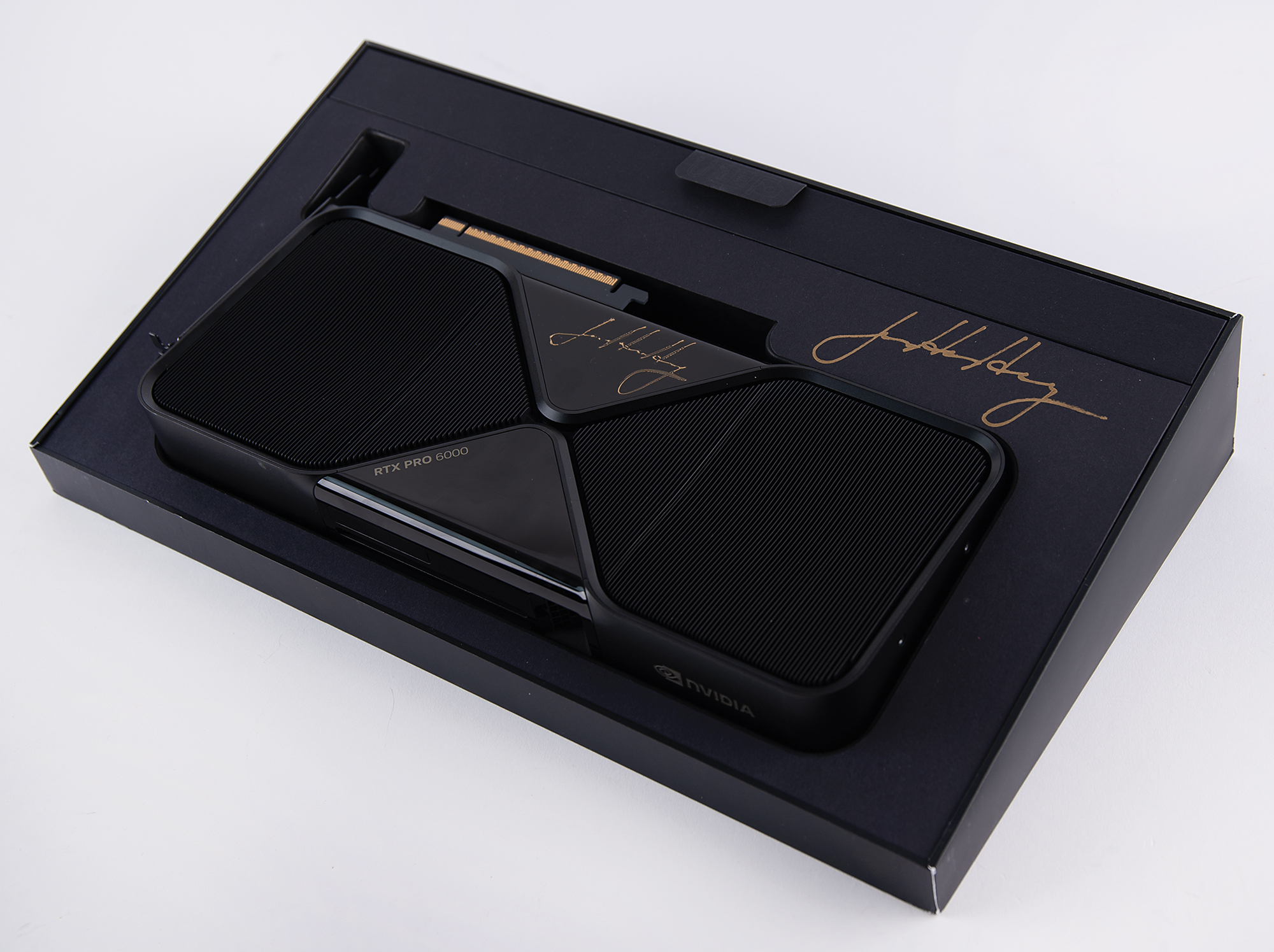 Photo: RR Auction
Jensen Huang twice-signed RTX Pro 6000 Blackwell
NVIDIA · 2026$57,450
Incl. premium · RR Auction · 20 Aug 2026
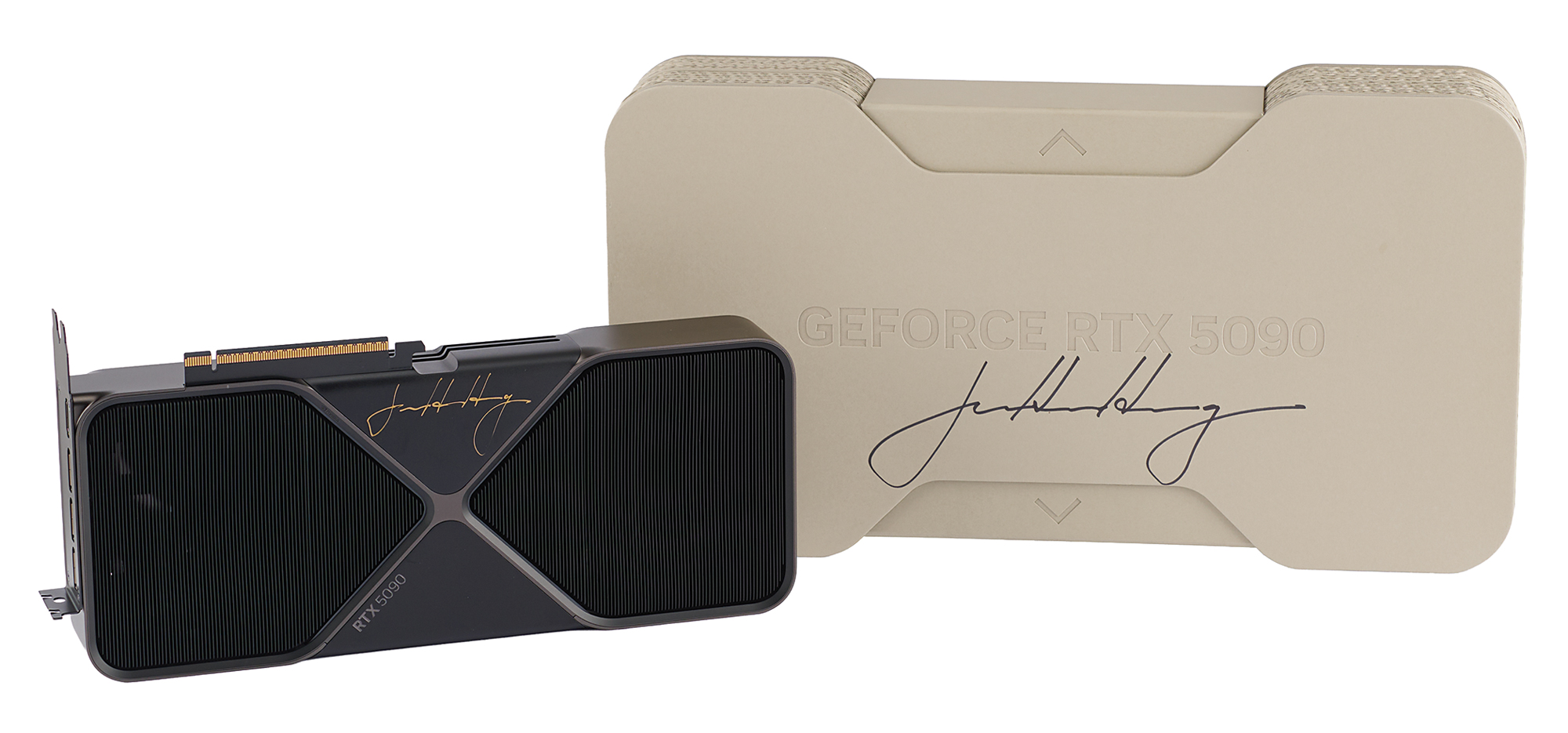 Photo: RR Auction
Jensen Huang signed GeForce graphics cards
NVIDIA$12,501
Incl. premium · RR Auction · 29 Jan 2026
 Photo: RR Auction
Jensen Huang signed photograph
NVIDIA$1,169
Incl. premium · RR Auction · 20 Aug 2026
 Photo: Sotheby's
Jensen Huang worn and signed Tom Ford leather jacket
Tom Ford · 2023$960,000
Reported · Sotheby's · 17 Jul 2026