Historic MomentsSpace ExplorationLanding Zone 1, Cape Canaveral, Florida, USA
21 Dec 2015
The first Falcon 9 booster landing
The first orbital-class booster to come back and land now stands 165 feet tall on a street corner in Hawthorne. Its whereabouts are about as public as a relic's can be.
 Photo: Bryce Allen, via collectSPACE
What happened Documented
On 21 December 2015 a Falcon 9 first stage that had helped launch 11 Orbcomm satellites returned to Landing Zone 1 at Cape Canaveral, the first orbital-class booster to land near its launch site. It was test-fired at Complex 40 on 15 January 2016, then shipped to California in June.
On 20 and 21 August 2016 SpaceX erected it as a 165-foot monument at the corner of Jack Northrop Avenue and Crenshaw Boulevard, at the south-east corner of its Hawthorne headquarters. Elon Musk said: 'It's kind of unique. It's the first one we brought back.' collectSPACE listed it again in September 2023 as standing outside SpaceX headquarters.
Why it matters Editorial view
Reusable boosters are the basis of SpaceX's economics, and this is the first one recovered. Unlike most history-used objects, it was preserved deliberately and put on public view by its maker within a year.
That makes it a useful benchmark. When a company treats an object as a monument, its whereabouts are settled; the open questions move to the smaller things that flew with it.
History used. Where is it now?
- 01Held by the company
Falcon 9 first stage B1019
Its roleLaunched the Orbcomm OG2 satellites and made the first landing
IdentifiersB1019; flight F9-020 per Wikipedia's booster list (collectSPACE calls the stage 'F9-021')
Whereabouts
On vertical outdoor display at SpaceX, Jack Northrop Avenue and Crenshaw Boulevard, Hawthorne, California, since August 2016 (collectSPACE, 2016), still listed there by collectSPACE in September 2023 and shown there by Teslarati in 2018. Wikipedia's booster list gives its status as retired and on display at SpaceX headquarters.
Open questions
- Is it still standing in late 2026? The latest dated source we read is from September 2023.
- Why does collectSPACE call it F9-021 while booster lists use B1019 and flight F9-020?
What we could not confirm
Wikipedia dates the launch 22 December 2015 (UTC); collectSPACE gives 21 December (US local time). No dated 2025 or 2026 source confirms the display's current state, though Wikipedia's list, read on 24 November 2026, still shows it at SpaceX headquarters.
Sources
More moments in Space Exploration
 Photo: Unconfirmed author / Wikimedia Commons
28 Sep 2008Space Exploration
Falcon 1 reaches orbit on its fourth flight
After three failures, SpaceX's small rocket reached orbit from a Pacific atoll. Its dummy payload, Ratsat, is still up there. On the ground, almost nothing from the day has surfaced.
3 objects traced · 1 whereabouts unknown
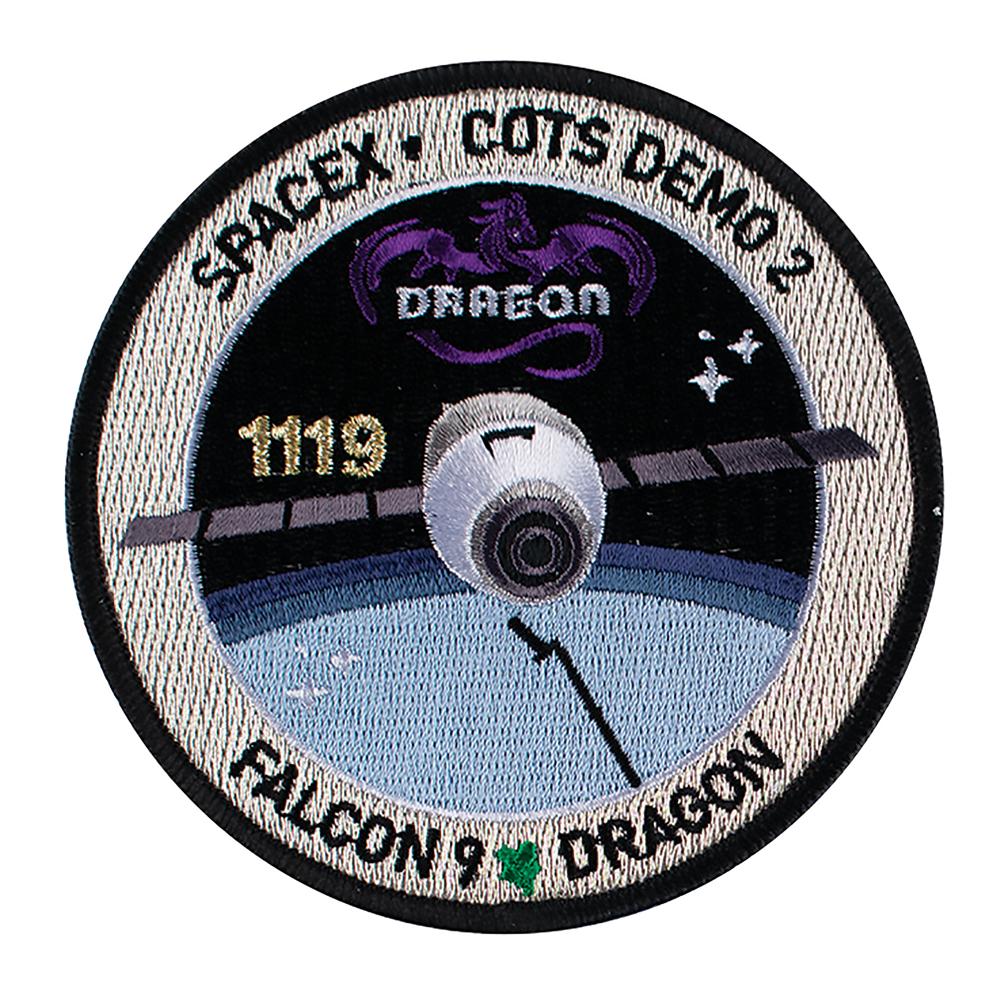 Photo: RR Auction
22 May 2012Space Exploration
Dragon's first mission to the space station
COTS Demo Flight 2 took a SpaceX Dragon to the International Space Station. SpaceX flew 2,500 patches aboard and gave them to staff on numbered certificates. One has a public sale on record.
1 object traced
 Photo: Scott Gilbert, via american-spacecraft.org
30 Mar 2017Space Exploration
The first reflight of an orbital-class booster
Booster B1021 flew for the second time on the SES-10 mission, a first for an orbital rocket. It is reported to stand outside a satellite TV company's headquarters, and a numbered grid-fin fragment has sold.
2 objects traced