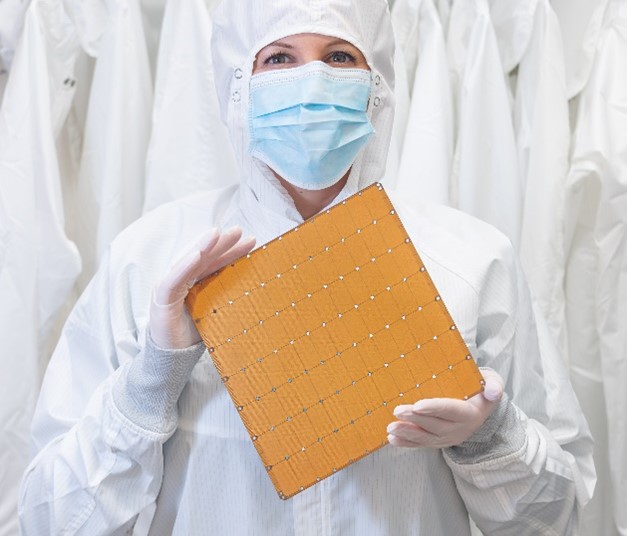
 Photo: Computer History Museum
Photograph © Computer History Museum. Original ↗
Cerebras Wafer-Scale Engine (WSE-2)
A single chip cut from a whole silicon wafer, about 8.5 inches on a side. The Computer History Museum took one into its permanent collection in 2022. Nobody can buy one loose.
- Maker
- Cerebras Systems
- Year
- Undated
- Category
- AI Hardware
No public price
Not for sale · None found
Relic Score
How we scoreMuseum accession gives it stronger institutional documentation than almost any AI chip. Nothing has been offered or sold, and nothing is known to be obtainable.
The three questions we ask of every object
- Why is it rare?
- Cerebras has not said how many wafers exist and does not sell them loose. One WSE-2 is documented, in the Computer History Museum's permanent collection, and none is known in private hands.
- What story does it tell?
- An entire silicon wafer used as one processor, about 8.5 inches on a side, taken into a museum collection in 2022 while the technology was still current.
- Why would someone want it in 2050?
- It reads as an artefact from across a room, which most AI chips do not. Whether anyone can own one depends on Cerebras releasing a wafer with paperwork, and no public offer has ever been found.
The record
DocumentedThe Cerebras Wafer-Scale Engine is a single chip cut as a square from a 300mm silicon wafer.
On 3 August 2022 the Computer History Museum in Mountain View announced that it had brought a WSE into its permanent collection and put it on display for a limited time. Curator Dag Spicer's post describes a device about 8.5 inches on a side, with about 2.6 trillion 7-nanometre transistors and 850,000 AI-optimised cores. Those figures correspond to the second-generation chip, the WSE-2.
A search listing of the museum's online catalogue titles the object 'Cerebras Wafer-Scale (WSE-2)', number 102807535. The catalogue page itself did not load when we tried to read it.
Cerebras does not sell the wafer as a loose component. It sells complete systems and cloud access. We found no public offer and no auction sale of a wafer.
Why it matters
Editorial viewMost AI chips are anonymous rectangles under a heat sink. This one looks like what it is: an entire wafer used as one processor, large enough to read as an artefact from across a room. That legibility is part of why a museum could put it in a case while the technology was still current.
The accession is the important fact. A museum's decision to collect is a judgement about history made by people whose job is to make it, and here it was made early. IBM's Watson server, given to the same museum in 2014, is the closest parallel.
The limit is that the judgement applies to one example in Mountain View. There is no private market, no published production figure and no account of a wafer anywhere else.
Rarity
Not documentedNot published. One WSE-2 is documented in the Computer History Museum's permanent collection. Cerebras has not said how many wafers exist, and none is known to be in private hands.
What to look for
- 01The museum example first. Catalogue number 102807535 at the Computer History Museum is the one documented reference.
- 02A letter from Cerebras naming the generation and stating how the wafer left the company.
- 03Whether it is a functional part, a test wafer or a reject. A seller should be able to say, and to show how they know.
- 04The original mount or carrier. A wafer without one has been handled in ways nobody recorded.
Will a Cerebras wafer ever be something a private collector can own?
What follows is Future Relics’ editorial opinion. It is an argument about cultural significance, not a price forecast. We may be wrong, and we keep our old theses online when we are.
Not by any route we can document today. The thesis is worth stating anyway, because this is the rare piece of AI hardware whose historical standing has already been settled by an institution.
The argument for the object is unusually strong. It is physically singular: one chip from one wafer. It has a museum accession, with a curator's name and a catalogue number attached, made within the working life of the technology. The first DGX-1, the most storied machine in this field, has no institutional record at all. The Cerebras wafer already has one.
The argument against is that there is nothing to collect. Cerebras sells systems and cloud time, not wafers. We found no offer, no auction lot and no account of a wafer in private hands. We do not know how many have been made, how the museum obtained its example, or whether the company releases display pieces to anyone. A thesis with no object is a wish.
So this entry is a watch notice. If a wafer does surface, the questions are the ones the museum's example answers and a loose one would not: which generation it is, whether it is a working part or a reject, and who released it. A wafer with a letter from Cerebras would be a serious object. A wafer with only a seller's story would be a large and beautiful piece of silicon of unknown origin. We have no evidence that either exists outside Mountain View.
Precedents
- IBM Watson (2011): one of the 90 servers of the Jeopardy! system was donated to the Computer History Museum in November 2014, three years after the event. Museum first, market never: no public sale of an original Watson server has been found.
- Google TPU (2015): Google says it built more than 100,000 first-generation TPUs. None is known to have been sold, and no museum holding was found. Proprietary AI chips usually leave no objects behind; the Cerebras wafer is the exception because one was placed in a museum.
- The first NVIDIA DGX-1 (2016): a single documented machine with no museum accession, no sale and no known location. The WSE-2 is the opposite case: a known location and no market.
What would prove us wrong
- There may never be a legitimate supply. Nothing in our sources suggests Cerebras releases wafers on their own.
- Authentication would be hard. Without a maker's letter there is no register, serial list or published production figure to check a loose wafer against.
- Our own identification is second-hand. The museum's post gives figures that match the WSE-2, and the catalogue title naming it was seen only in a search listing.
- Fragility. It is a bare slab of silicon; how the museum mounts and protects its example is not described, and a private owner would be guessing.
How to acquire
Not sold as a loose component: Cerebras sells complete systems and cloud access. We found no public offer and no auction sale of a wafer. The one documented example is in the Computer History Museum's permanent collection.
How to preserve
We collected no sourced preservation information. As general advice, not a sourced finding: a bare silicon wafer is brittle and easily scratched, so it should stay in whatever mount or case it came in and should not be handled directly.
Where it stands
- None found ↗
No retail or auction offer of a WSE wafer was located. Cerebras sells complete systems and cloud access.
Not for saleChecked 24 Nov 2026
Asking prices and stock are as observed on the date shown and change without notice. Future Relics does not sell these objects and currently earns no commission on these links.
What we could not confirm
We give no year. The first-generation WSE, reported as announced on 19 August 2019 with 1.2 trillion transistors, appears only in search results, and the museum's post does not date the WSE-2. The catalogue title and number were seen in a search listing; the catalogue page itself did not load. How the museum acquired the wafer, by gift or otherwise, is not stated.
Sources
- [1]Computer History Museum blog: The Biggest Chip in the World (3 Aug 2022) · computerhistory.org ↗
- [2]Computer History Museum catalogue: object 102807535 · computerhistory.org ↗
- [3]Computer History Museum press release: IBM Watson server donation (20 Nov 2014) · computerhistory.org ↗
- [4]Google Cloud: TPU transformation, 10 years of AI-specialised chips (31 Jul 2024) · cloud.google.com ↗
- [5]Fortune: Elon Musk's OpenAI gets NVIDIA supercomputer (15 Aug 2016) · fortune.com ↗
Record opened 24 Nov 2026 · Last verified 24 Nov 2026