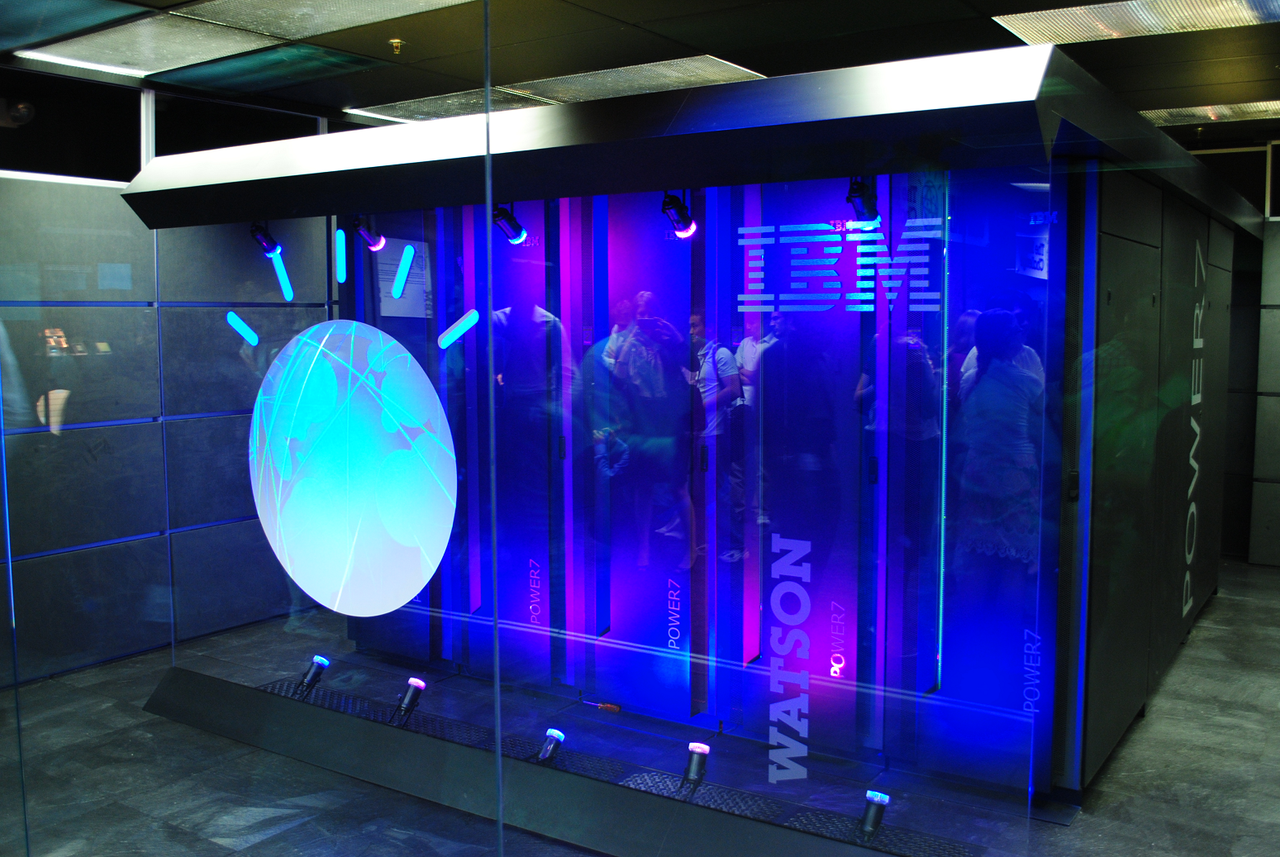
 Photo: Clockready / Wikimedia Commons, licence CC BY-SA 3.0
Photograph © Clockready / Wikimedia Commons, licence CC BY-SA 3.0. Original ↗
IBM Watson server from the Jeopardy! system
One of the 90 servers that made up the Watson system on Jeopardy! in 2011, given by IBM to the Computer History Museum three years later. The clearest model for how an AI milestone machine gets preserved.
- Maker
- IBM
- Year
- 2011
- Category
- Tech History
No public price
Value unproven
Relic Score
How we scoreA landmark of AI history with a museum accession and a named donor. No Watson server has ever been publicly sold.
The three questions we ask of every object
- Why is it rare?
- The Watson system on Jeopardy! in 2011 was made up of 90 servers. One is documented, given by IBM to the Computer History Museum in 2014. The fate of the other 89 is unrecorded.
- What story does it tell?
- A server that took part when IBM's Watson competed on Jeopardy! in 2011, and the clearest case of how an AI milestone machine is preserved: chosen by its maker and given to a museum.
- Why would someone want it in 2050?
- Because it physically took part in the event. The catch is that it is a standard IBM model: only IBM's word and a museum record make a server a Watson server, so any other example would need the same proof.
The record
DocumentedThe original IBM Watson system, which competed on the quiz show Jeopardy! in 2011, was made up of 90 IBM POWER 750 servers.
On 18 November 2014 Ginni Rometty, then IBM's chairman and chief executive, announced the donation of one of those servers to the Computer History Museum. The museum confirmed its entry into the permanent collection in a press release of 20 November 2014 and planned a temporary display in 2015. Senior curator Dag Spicer called Watson 'a seminal achievement in the history of artificial intelligence'.
We found no public sale of an original Watson server, and no account of what became of the other 89.
Why it matters
Editorial viewThis is the best-documented case of an AI milestone machine entering a museum, and it shows how such things actually happen. The company decided the event was historic, chose one unit from many to stand for the whole, and gave it away with a press release. No market was involved at any point.
That is the precedent for today's objects. When collectors ask what will become of the first DGX-1, or of the hardware behind a famous model, Watson is the answer on record: three years from event to accession, by corporate gift, to an institution. It suggests that the most important machines of this era are more likely to be donated than sold.
It also carries a warning. The museum's server is one of 90 units of a standard IBM model. What makes it a Watson server is IBM's word and the museum's record, and nothing else would.
Rarity
Documented90 servers made up the original system, per the Computer History Museum. One is documented in the museum's permanent collection. The fate of the others is not recorded in our sources.
Classification
- History Used
EvidenceOne of the 90 POWER 750 servers of the Watson system that competed on Jeopardy! in 2011, donated by IBM, per the Computer History Museum's press release of 20 November 2014.
What to look for
- 01IBM's own documentation. The museum's server is a Watson server because IBM said so when it donated it; any other would need the same.
- 02A serial number tied to the 2011 system in IBM's records. The model name alone, POWER 750, proves nothing.
- 03The museum example as the reference. It is the only one with a public record.
What we could not confirm
The parallel case of IBM's Deep Blue, said to be split between the Smithsonian's National Museum of American History and the Computer History Museum, was seen only in search results; the Smithsonian's object page could not be read, so it is not relied on here. The curator's words are quoted from a summarised press release and should be checked at the source. We collected no sourced information on preservation. The photograph shows the Watson system, not the single museum server.
Sources
Record opened 24 Nov 2026 · Last verified 24 Nov 2026