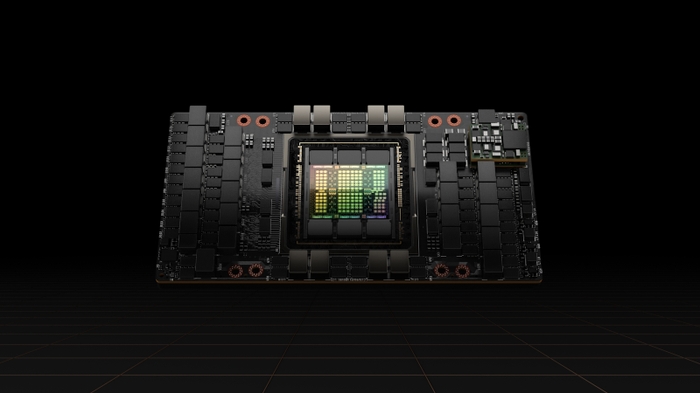
 Photo: NVIDIA
Photograph © NVIDIA. Original ↗
NVIDIA H100
NVIDIA's 2022 data-centre flagship, sold to cloud providers and data centres and never to the public. Whether a part like that can become a relic is an open question, and its predecessors are not encouraging.
- Maker
- NVIDIA
- Year
- 2022
- Category
- AI Hardware
No public price
Value unproven
Relic Score
How we scoreImportant as a type, in our judgement, and documented only at launch. No price was ever published and no unit has sold as a collectible.
The three questions we ask of every object
- Why is it rare?
- It is not known to be. NVIDIA published no production figures and no individual unit is documented. A first unit with a documented delivery, like the DGX H200 handed to OpenAI in 2024, would rank far higher, and no such H100 is on record.
- What story does it tell?
- The data-centre phase of the AI boom: a chip announced in March 2022, sold to cloud providers and never to the public, whose name became shorthand for computing power.
- Why would someone want it in 2050?
- Probably few will want an anonymous card. A unit documented as having run in a named cluster would be different, and nobody has yet mapped how such provenance would be kept.
The record
DocumentedNVIDIA announced the H100 at GTC on 22 March 2022 as the first GPU of its Hopper architecture, named after the computer scientist Grace Hopper. It has 80 billion transistors, is built on TSMC's 4N process, and was the first GPU with HBM3 memory and PCIe Gen5.
NVIDIA said it would be available from the third quarter of 2022, with cloud instances planned by Alibaba Cloud, AWS, Baidu AI Cloud, Google Cloud, Microsoft Azure, Oracle Cloud and Tencent Cloud. NVIDIA never published a list price.
Its predecessor in the data-centre line was the A100, announced on 14 May 2020 as the first GPU on the Ampere architecture, with more than 54 billion transistors on a 7nm process. The A100 was already in full production when it was announced. Its named early adopters included Microsoft, DoorDash, Indiana University, the Juelich Supercomputing Centre, Karlsruhe Institute of Technology, the Max Planck Computing and Data Facility and NERSC, for its Perlmutter system, and an eight-GPU DGX A100 system was available immediately.
In April 2024 Jensen Huang hand-delivered the first DGX H200 system, from the generation that followed the H100, to OpenAI. We found no comparable 'first H100' on record.
Why it matters
Editorial viewIn our judgement the H100 is the component that best stands for the data-centre phase of the AI boom: a chip sold to cloud companies, not to people, whose name became shorthand for computing power. That is an editorial reading. What our sources document is narrower: a launch date, a specification and a list of seven cloud providers.
It is also a test case. The earlier objects in this lineage that collectors can hold were things an individual could buy: a GeForce 256, a GTX 580. The H100 was sold to institutions through OEMs. If hardware of that kind is going to be collected at all, it will be by a route nobody has yet mapped.
We have folded the A100 into this record. It has the same kind of history, a press release and a list of customers, and nothing in our sources that would let a collector tell one A100 from another.
Rarity
Not documentedNot published. NVIDIA has given no production figures for the H100 or the A100, and no individual unit of either is documented.
What to look for
- 01A documented origin: the name of the operator and the cluster it came from, with a decommissioning or sale record.
- 02A complete system where possible. The documented first units in this family were DGX systems, not loose GPUs.
- 03Proof of lawful export and import if the card has crossed a border.
- 04Evidence that it works. A data-centre card with no test record is a part number and nothing more.
Can a data-centre GPU that was never sold to the public become a collector's object?
What follows is Future Relics’ editorial opinion. It is an argument about cultural significance, not a price forecast. We may be wrong, and we keep our old theses online when we are.
Our answer: as a type specimen, perhaps. As a relic, only with a story attached, and no such story is on record yet.
The case for the H100 is its place in the sequence. NVIDIA's own telling runs from the GeForce 256 through AlexNet's graphics cards to the DGX systems, and the H100 is where that line had arrived by 2022: a chip announced with seven cloud providers already lined up. It has a memorable name, a clean launch date and a specification full of firsts. A collection that tries to show AI hardware generation by generation has an H100-shaped gap in it.
The case against is everything that normally makes an object collectible. There is no edition, no retail box, no launch-day queue and no published price. The cards went into servers owned by cloud providers, and what leaves a data centre is a used part with no history attached. The Tesla K80 of 2014 took the same path, and twelve years later we could find nothing about it beyond its press release. The A100 of 2020 is going the same way: named early adopters, no named objects.
What would change the answer is provenance. A card documented as coming out of a specific, named cluster would be a different thing from an anonymous one, in the way that one server from IBM's Jeopardy! system is a museum piece and an identical model is not. The same goes for anything from the hand-delivery tradition: the first DGX H200 went to OpenAI in April 2024 with a dedication. Nothing of either kind involving an H100 is known to be available. Until it is, an H100 is a significant chip and an undocumented object.
Precedents
- IBM Watson (2011): 90 POWER 750 servers made up the Jeopardy! system. One, donated by IBM in November 2014, is in the Computer History Museum. Institutional hardware becomes historic one documented unit at a time.
- NVIDIA Tesla K80 (2014): sold only through server makers, with no published price. No documented example, sale or museum holding turned up in our research. That is the default fate of a data-centre card.
- Jensen Huang signed RTX Pro 6000 (2026): $57,450 at RR Auction, against $12,501 for a signed RTX 5090 Founders Edition earlier the same year. The one professional AI card with a sale on record owed its price to a signature, an event and a letter, not to the silicon.
What would prove us wrong
- Supply. Production figures are unpublished, the announced customers were major cloud providers, and nothing limits how many decommissioned cards reach the used market.
- No provenance by default. A used H100 comes with a part number, not a history, and a claim that a card trained a particular model would be close to impossible to prove.
- Restricted movement. Export of these chips to China and Russia has reportedly required a United States licence since 2022. We saw this only in search results, but anyone moving one across a border should check the current rules.
- It is a server component with no function outside a compatible system and no packaging designed to be kept.
- No market evidence as a collectible. No H100 has sold at auction in any source we read.
How to acquire
Sold new to data-centre customers through OEMs, not to individuals. A used market exists, but we could not verify any price on a page we read; the dealer figures seen in search results are set out under uncertainties. Export to China and Russia has reportedly required a United States licence since 2022 (search results only).
How to preserve
We collected no sourced preservation information. As general advice, not a sourced finding: keep the card in anti-static packaging in a dry, stable environment, protect its connectors, and keep any asset tags, invoices or decommissioning paperwork with it, since paperwork is the only provenance a data-centre part is likely to have.
What we could not confirm
NVIDIA never published an H100 list price; every price figure is third-party. Dealer and appraisal sites seen only in search results quote roughly $15,000 to $28,000 for used cards in 2026, down from peaks near $40,000 to $50,000 in mid-2024: treat these as unverified. The export licence requirement and a $199,000 starting price for the DGX A100 were also seen only in search results.
Sources
- [1]NVIDIA press release: NVIDIA announces Hopper architecture (22 Mar 2022) · nvidianews.nvidia.com ↗
- [2]NVIDIA press release: Ampere data centre GPU in full production (14 May 2020) · nvidianews.nvidia.com ↗
- [3]Analytics India Magazine: Jensen Huang personally delivers first NVIDIA DGX H200 to OpenAI (25 Apr 2024) · analyticsindiamag.com ↗
- [4]NVIDIA press release: Tesla K80 (17 Nov 2014) · nvidianews.nvidia.com ↗
- [5]NVIDIA Blog: 25 years of the GeForce 256 (11 Oct 2024) · blogs.nvidia.com ↗
- [6]Computer History Museum press release: IBM Watson server donation (20 Nov 2014) · computerhistory.org ↗
- [7]RR Auction, lot 4200: Jensen Huang twice-signed NVIDIA RTX Pro 6000 · rrauction.com ↗
- [8]RR Auction, lot 6160: Jensen Huang twice-signed RTX 5090 Founders Edition · rrauction.com ↗
Record opened 24 Nov 2026 · Last verified 24 Nov 2026
More from NVIDIA
Company file →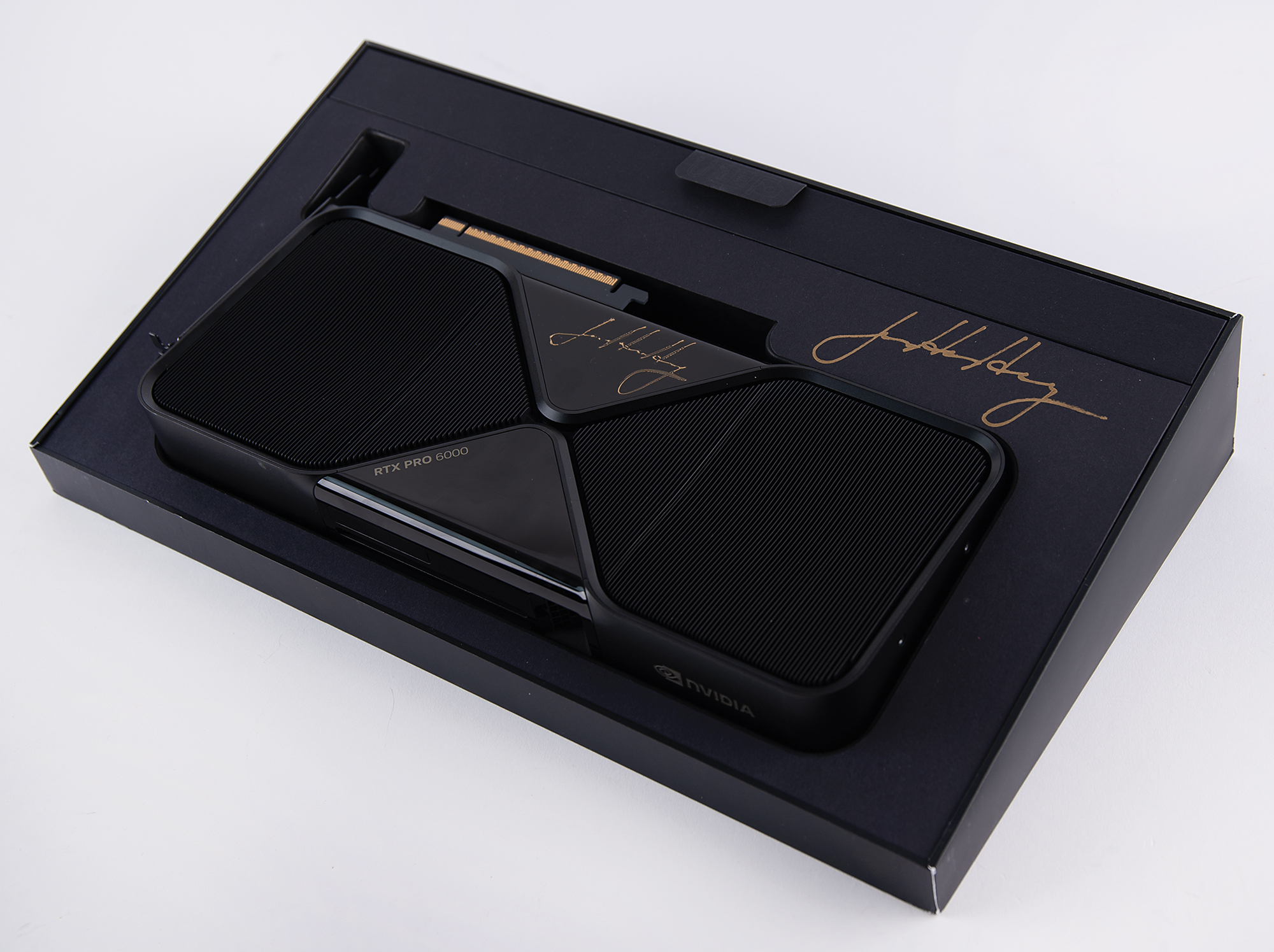 Photo: RR Auction
Jensen Huang twice-signed RTX Pro 6000 Blackwell
NVIDIA · 2026$57,450
Incl. premium · RR Auction · 20 Aug 2026
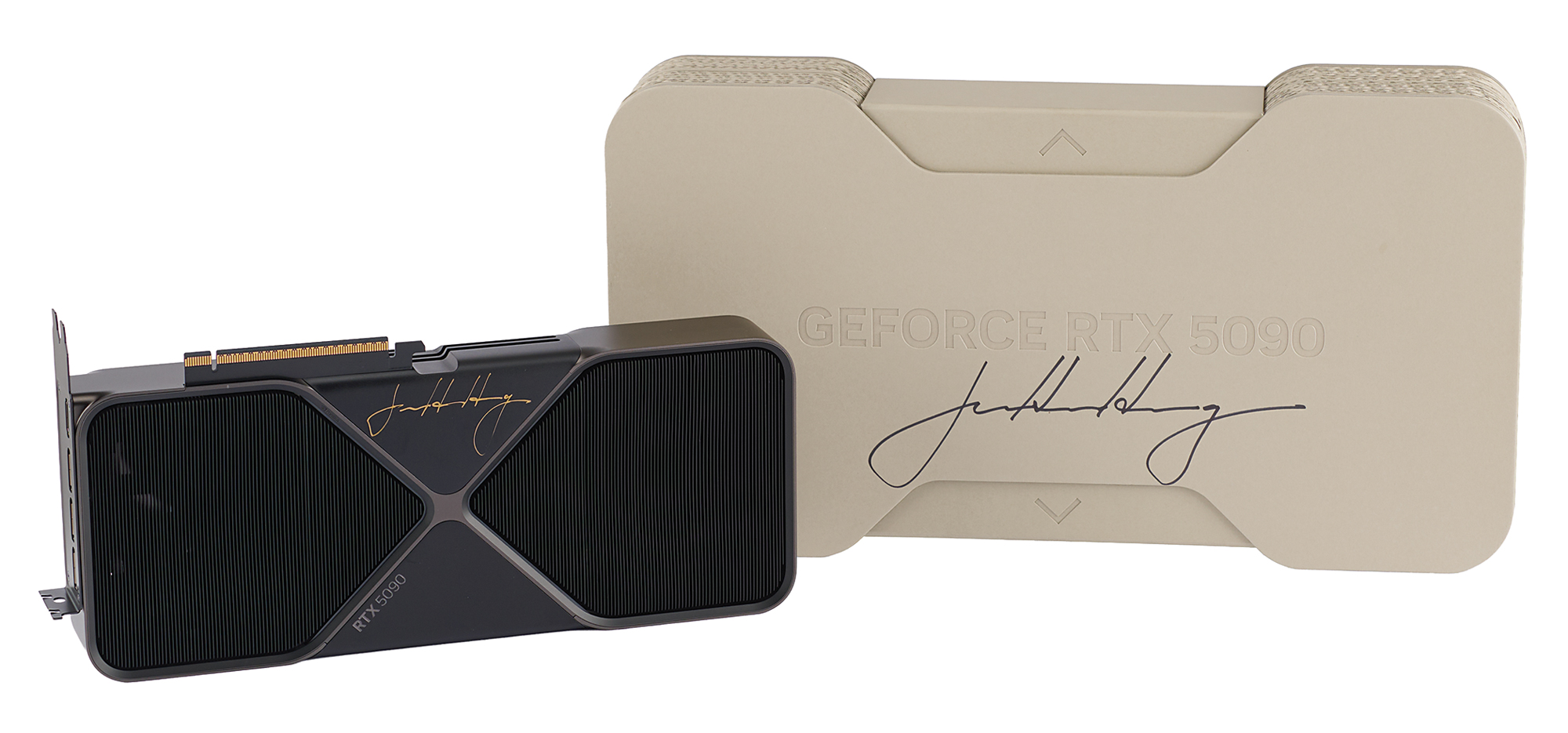 Photo: RR Auction
Jensen Huang signed GeForce graphics cards
NVIDIA$12,501
Incl. premium · RR Auction · 29 Jan 2026
 Photo: RR Auction
Jensen Huang signed photograph
NVIDIA$1,169
Incl. premium · RR Auction · 20 Aug 2026
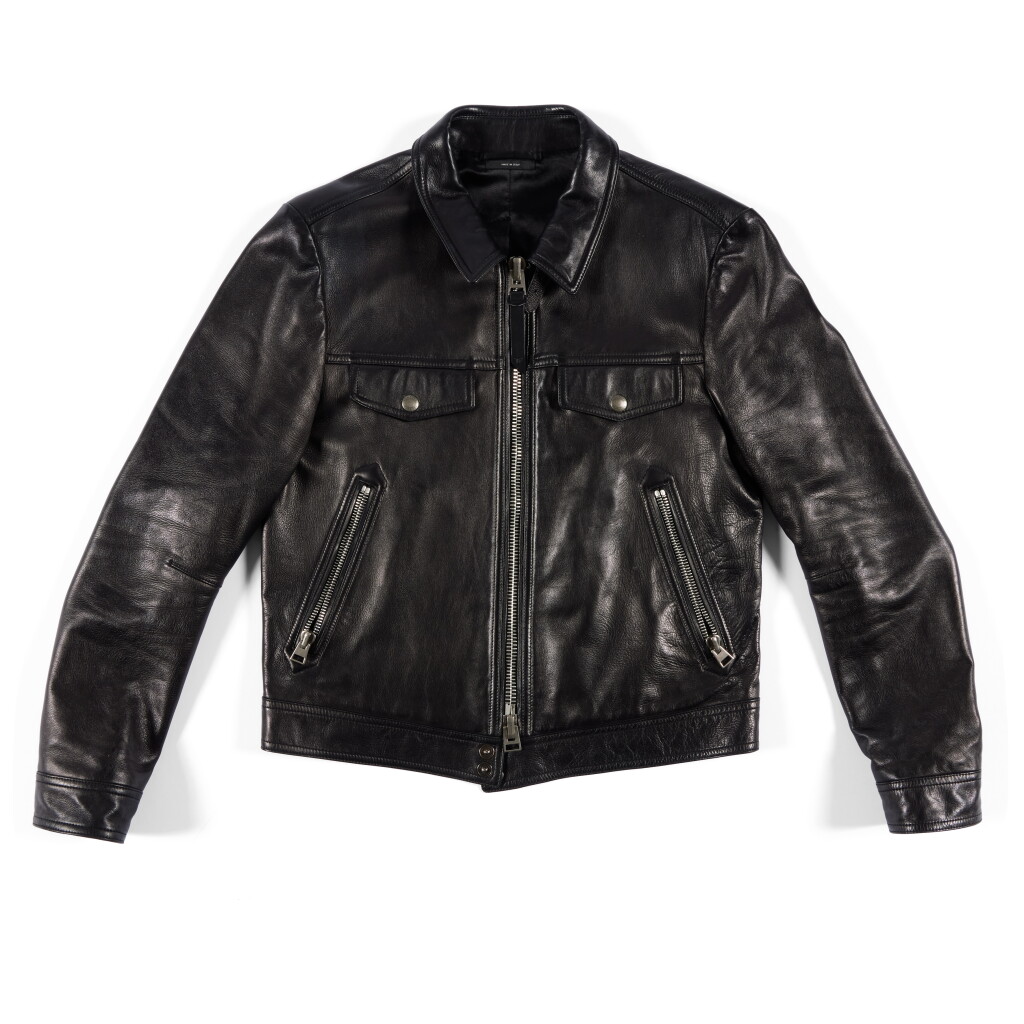 Photo: Sotheby's
Jensen Huang worn and signed Tom Ford leather jacket
Tom Ford · 2023$960,000
Reported · Sotheby's · 17 Jul 2026