 Photo: Steve Jurvetson / Wikimedia Commons, licence CC BY 2.0
Photograph © Steve Jurvetson / Wikimedia Commons, licence CC BY 2.0. Original ↗
Starlink first-generation round dish ('Dishy McFlatface')
The round dish from Starlink's 2020 'Better Than Nothing Beta'. SpaceX is now replacing them for free and switching the old ones off, which gives a mass-produced object a dated end.
$499 kit (October 2020 beta price)
Discontinued · SpaceX / Starlink
Relic Score
How we scoreThe first hardware of a service that changed its field, documented by press reports of SpaceX's own emails. No verified sale of any kind.
The three questions we ask of every object
- Why is it rare?
- It is not. Production is unpublished, and it was the standard Starlink terminal from the October 2020 public beta until late 2021. A complete 'Better Than Nothing Beta' kit with its original order paperwork would stand apart.
- What story does it tell?
- The dish through which Starlink's satellite internet first reached paying customers, sold with a warning that it would sometimes not work.
- Why would someone want it in 2050?
- As the first hardware of satellite internet for the public, now being switched off by its maker on a known date. Deactivated dishes will stay in circulation, so paperwork from the 2020 beta is what counts.
The record
DocumentedSpaceX opened Starlink's public beta, which it called the 'Better Than Nothing Beta', with emails sent on 26 October 2020. The terms were $99 a month plus $499 upfront for the Starlink Kit: a user terminal, a mounting tripod and a Wi-Fi router. CNBC reported that the email promised speeds of 50 to 150Mb/s and warned that there would be brief periods with no connectivity at all.
The original terminal is the round dish nicknamed 'Dishy McFlatface'. SpaceX replaced it with a smaller rectangular dish in late 2021.
In November 2026, according to Not a Tesla App, Starlink began emailing early customers still using the round dish with an offer of a free replacement Standard kit, with a V4 dish and Router 3. Under that programme the old dish is deactivated when the new one goes online or 14 days after delivery, whichever comes first. It cannot be transferred to another user and does not have to be returned.
Why it matters
Editorial viewThis is the object through which Starlink's satellite internet first reached paying customers: a dish on a tripod, sold with a warning that it would sometimes not work. The beta's name is itself a small piece of the history, an unusually candid label for a product launch.
The 2026 replacement programme is what makes it a catalogue entry now. Six years on, the maker has reached into the field and scheduled the end of its own first hardware. Each swapped dish stops working on a known date and stays with its owner. That is unusual: a mass-produced device with a documented moment of retirement, left in private hands.
It is also a blunt lesson in service-dependent hardware. The dish was bought and paid for, and it works only as long as SpaceX says so.
Rarity
Not documentedProduction of the round dish has not been published. It was the Starlink terminal from the October 2020 public beta until it was replaced in late 2021, so there is no reason to think it scarce. Deactivated examples will remain in circulation, because owners keep them after the swap.
- Edition type
- Regular merchandise
- Launched
- 26 Oct 2020
- Launch price
- $499 kit, plus $99 a month
Public beta, opened by email invitation. Earlier private-beta kits were not researched.
Classification
- First Edition
EvidenceThe original Starlink user terminal, supplied in the October 2020 public beta kit per CNBC, and replaced by a rectangular dish in late 2021.
What to look for
- 01A complete kit: round dish, mounting tripod and the first-generation Wi-Fi router, ideally in the original box.
- 02The paperwork. A 'Better Than Nothing Beta' invitation email or an order record dated from October 2020 is what separates a beta kit from a later round dish.
- 03Its status. A dish swapped under the 2026 programme is deactivated and cannot be transferred, so buy it as a display object and expect nothing more.
- 04An honest description. A claim that a deactivated dish can be put back into service is contradicted by the programme's own terms.
- 05The condition of a piece of outdoor equipment: weathering, and damage to the cable and connectors.
Will a switched-off Dishy be a relic of the satellite internet era, or just scrap with a nickname?
What follows is Future Relics’ editorial opinion. It is an argument about cultural significance, not a price forecast. We may be wrong, and we keep our old theses online when we are.
A few of them could be relics. Most will be scrap, and the difference will be paperwork.
The case for the round dish is that it is unambiguously first. It is the original Starlink terminal, it went out with the October 2020 public beta, and it has a name people remember. Its replacement programme gives it something most mass products never get: a dated end. From November 2026, dishes are being deactivated one household at a time, and SpaceX is not asking for them back. That is how common objects usually become uncommon. Few people keep a dead dish, its tripod, its router and its box together. In twenty years a complete beta kit with its invitation email may be hard to find. That is an argument about attrition, not a fact.
The case against is that the dish was made in numbers SpaceX has never published, was the terminal on sale for about a year, and is an awkward thing that has spent its life outdoors. A deactivated one does nothing. By the terms of the programme it cannot be put back into service or transferred. And first-generation consumer hardware is not automatically interesting: what people remember of Starlink may be the service, not the dish.
So the thesis is narrow. The example that could matter is a kit traceable to the October 2020 beta, complete with tripod and router, with the email or order record that proves the date. A loose round dish from 2021 with no history is a souvenir.
Precedents
- Sony AIBO ERS-110 (1999): Sony ended the line in 2006 and, according to Wikipedia, stopped repairing older models in 2014. The objects outlasted their maker's support, and one is now in the collection of M+ in Hong Kong.
- Tesla Roadster (2008): Tesla's first product. About 2,450 were built, and the recorded sales are of documented early cars, such as Signature One Hundred no. 38 at a final bid of $182,000 in 2021.
- Tesla Cybertruck Foundation Series (2023): a first-run label on a volume product. One was listed at $249,999 in February 2024; by October 2024 the series had ended and the standard truck could be ordered from $79,990. Being first is not enough without scarcity.
What would prove us wrong
- Unknown supply. SpaceX has never published how many round dishes it made, and it was the terminal on sale for about a year.
- A deactivated dish is inert. By the programme's terms it no longer functions and cannot be transferred, so it can only ever be displayed.
- Beta provenance is hard to prove. The proof is an email and an order record, which are easy to lose and not hard to imitate.
- No resale evidence. We collected no verified price for a round dish, working or not.
How to acquire
No longer sold new. The kit cost $499 in the October 2020 public beta. Today it is second-hand only, and we collected no verified resale prices. Dishes swapped under the November 2026 replacement programme are deactivated and non-transferable, so they survive only as display objects; owners are not required to return them.
How to preserve
This is service-dependent hardware. By the terms of the replacement programme, a deactivated round dish no longer functions and cannot be transferred. SpaceX has not said whether service to the remaining round dishes will end. Starlink is also reported to have ended software and security updates for the first-generation Wi-Fi router, a point we saw in search results only. Keep the dish, tripod, router, cables and box together with the beta email or order record. Beyond that, general advice for outdoor electronics applies: clean and dry it before storage.
Where it stands
- SpaceX / Starlink ↗
Round dish superseded in late 2021. Free replacement programme under way in November 2026.
$499 kit (October 2020 beta price)DiscontinuedChecked 24 Nov 2026
Asking prices and stock are as observed on the date shown and change without notice. Future Relics does not sell these objects and currently earns no commission on these links.
What we could not confirm
SpaceX has not said whether service to the remaining round dishes will end. The end of updates for the first-generation router was seen in search results only. Earlier private-beta kits, before October 2020, were not researched. The replacement programme's terms are as reported by Not a Tesla App, not read from a SpaceX document. Figures were taken from summarised readings of the sources and should be checked against the originals.
Sources
- [1]CNBC: SpaceX prices Starlink at $99 per month, public beta begins (27 Oct 2020) · cnbc.com ↗
- [2]Not a Tesla App: Starlink is replacing OG 'Dishy McFlatface' dishes for free (5 Nov 2026) · notateslaapp.com ↗
Record opened 24 Nov 2026 · Last verified 24 Nov 2026
More from SpaceX
Company file →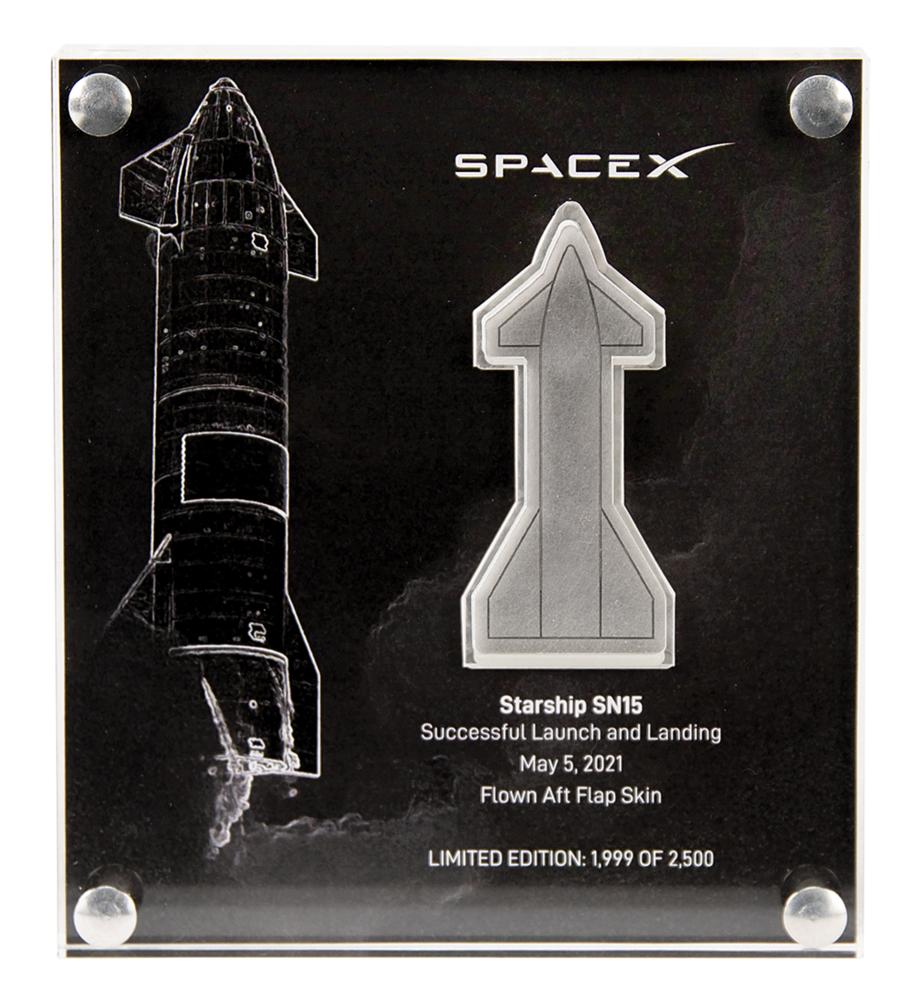 Photo: RR Auction
SpaceX flown Starship SN15 aft flap skin
SpaceX · 2021$2,276
Incl. premium · RR Auction · 19 Oct 2023
 Photo: SpaceX, via collectSPACE
SPCX Liftoff mission patch
SpaceX · 2026$15 (June 2026 launch price)
Status unverified · SpaceX Store
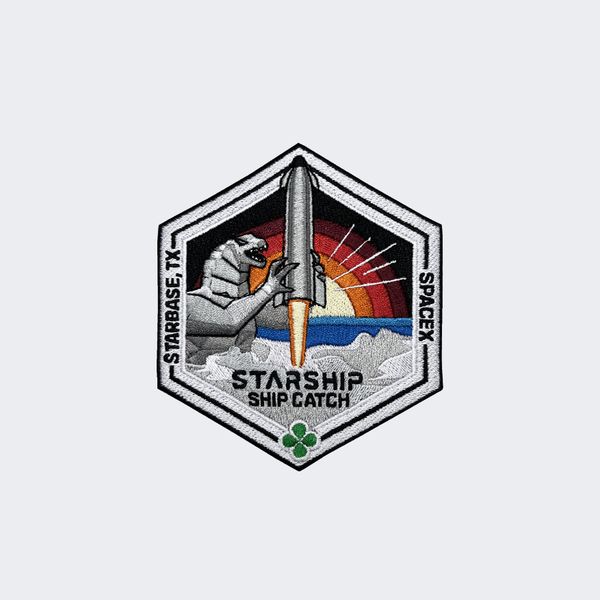 Photo: SpaceX
Starship Milestone Ship Catch Mission Patch
SpaceX · 2026$15
Asking · SpaceX Store · checked 24 Nov 2026
 Photo: Prime Minister's Office, Government of India / Wikimedia Commons, licence GODL-India
Flown Starship heat-shield tile given to Narendra Modi
SpaceX · 2025Not for sale (diplomatic gift)
Launch price · 13 Feb 2025