Collecting Intelligence24 Nov 20264 min read
What is the tech equivalent of Michael Jordan's $10 million jersey?
In 2022 a basketball shirt sold for $10.091 million, not because Jordan wore it, but because of the night he wore it. Technology has objects like that. Almost nobody is looking for them.
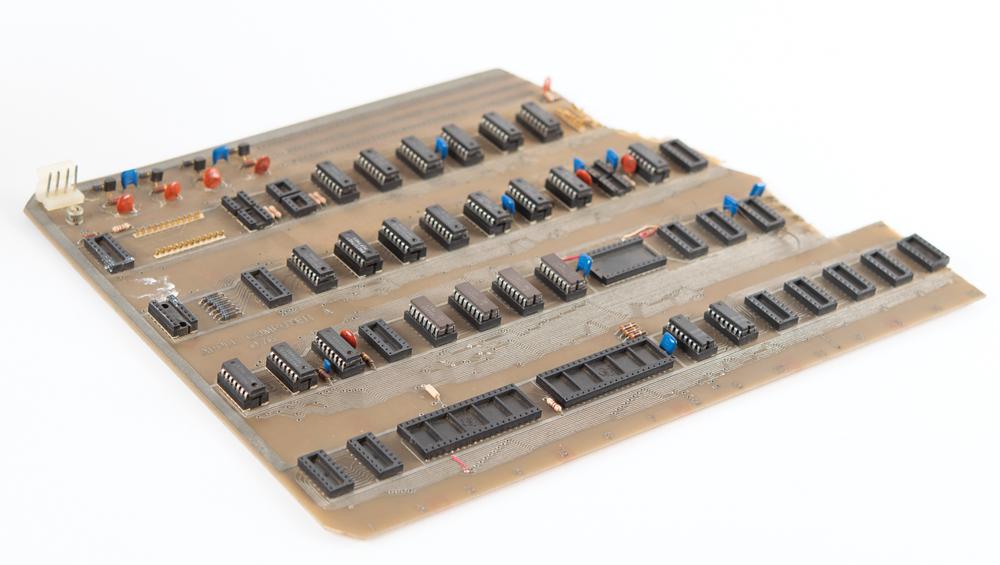 Photo: RR Auction
On 15 September 2022 a red Chicago Bulls shirt sold at Sotheby's for $10.091 million. The estimate had been $3 million to $5 million. Twenty bids took it past every record in sports memorabilia: Diego Maradona's "Hand of God" shirt, which had made $9.28 million that May, Babe Ruth's jersey, the Kobe Bryant rookie jersey, every Jordan item ever sold.
Michael Jordan wore a great many shirts. What made this one worth more than any of them was a date. He wore it in Game 1 of the 1998 NBA Finals, in Utah, on 3 June 1998, played 45 minutes and scored 33 points. The lot came with a certificate from a photo-matching specialist proving that this shirt, and no other, was on court that night.
Collectors have a name for this. They call it game-used, or game-worn. It is the most important idea in sports memorabilia, and the technology world has barely started to apply it.
Three kinds of value
There are three ways an object can be connected to a famous person.
It can be associated with them. A replica shirt, a licensed figure, a product they launched. Plentiful, pleasant, worth roughly what was paid for it.
It can be signed or owned by them. A signed photograph, a personal possession. Rarer, authenticated, sometimes valuable. Most of the tech-founder market lives here today.
It can have taken part in a historic moment. The object was physically there when the thing happened, and it can be proved. This is the jersey. It is where nearly all the extreme prices in mature collecting fields come from.
Future Relics calls this third kind History Used. It sits at the top of our tiers, and it is the thing we most want to find.
Technology already has its jerseys
The clearest example sold three weeks before the Jordan shirt.
On 18 August 2022 RR Auction sold an Apple-1 prototype board marked "Apple Computer A, (c) 76". According to the auction house, this is the board Steve Jobs used to demonstrate the computer to Paul Terrell of The Byte Shop in 1976, the demonstration that led to Apple's first order, for fifty machines. It is matched to Polaroid photographs Terrell took at the time, and documented in a thirteen-page report by an Apple-1 specialist.
It is cracked, incomplete and does not work. It made $677,196.
That is the jersey logic exactly. Nobody paid for the condition. They paid for the photograph that puts this board on the table on that day.
The founding objects
The Apple market is the one place in technology where this logic has been tested repeatedly, and the results are consistent.
In January 2026 RR Auction sold Apple's first cheque, written on 16 March 1976 for $500 and signed by Jobs and Wozniak, for $2,409,886. In the same sale the Celebration board, a pre-production Apple-1 used to check the corrected design before the first order was built, made $2.75 million. Years earlier, the founding partnership contract had made $1,594,500 at Sotheby's.
None of these is a product. Each is a document or a tool that was there in the weeks the company began. Meanwhile ordinary production Apple-1s, which are extremely rare, have mostly sold for $315,000 to $575,000.
Scarcity puts an object in the room. Being present at the moment is what multiplies the price.
What has already happened in AI
The AI era has produced at least one sale that follows the same rule.
In July 2026 Sotheby's sold a black Tom Ford leather jacket belonging to Jensen Huang. The detail that matters is on the lot page: PSA, a sports-memorabilia authenticator, photo-matched the jacket to Huang's appearance at Hon Hai Tech Day in Taipei on 18 October 2023. The estimate was $40,000 to $60,000. Fortune reported the result as $960,000. It was a charity sale, which can push prices up, but the method is unmistakably the one used for the Jordan shirt: a worn object, matched to a dated public appearance.
Compare Huang's signature on graphics cards. Four signed GeForce cards have sold at RR Auction for between $6,504 and $12,501. Same man, same ink. The difference between a signature and a moment is roughly two orders of magnitude.
The jersey nobody has found
If the AI era has a single object equivalent to the Finals jersey, we think it is a grey server.
In August 2016 Huang carried the first DGX-1, NVIDIA's first deep-learning supercomputer, into OpenAI's office in San Francisco, and wrote on the case: "To Elon and the OpenAI Team! To the future of computing and humanity. I present you the world's first DGX-1!" There is a photograph of the moment. Six years later OpenAI released ChatGPT.
It is a first unit, signed, documented by the company and the press, and present at the start of the story. It is History Used in the strictest sense. And no public record says where it is. We have opened a file on it.
What this means for anyone collecting now
The jersey teaches three practical lessons.
Ask what the object did, not only who touched it. A signature tells you who. A photo-match tells you when and where. The second is worth far more.
Documentation is created at the time or never. The Jordan shirt had a photo-match; the Apple prototype had Terrell's Polaroids; the jacket had a dated appearance. If you are in the room when something happens, write down which object was there, photograph it, and keep the paperwork with it.
The objects are still out there. The machine on stage at a launch, the robot that took the first public steps, the first unit delivered to a customer. Most of them were working tools and were treated as such. Some are in store rooms, some in garages, some already lost.
The technology era has its game-worn jerseys. Most of them have not yet been recognised as such, and most of their owners do not know what they have. That is the gap Future Relics exists to close.
Keep reading
Buy & Preserve24 Nov 20264 min read
A relic you cannot switch on
The Humane Ai Pin went from $699 launch to electronic waste in fifteen months. It is the best lesson available in what makes an AI device possible to keep.
 Photo: NVIDIA
Then vs. Now24 Nov 20264 min read
Is the DGX Spark the Apple-1 of the AI generation?
One was soldered by hand in a garage and sold through a single shop. The other is on the shelf at Best Buy. The comparison is still worth making, as long as you make it honestly.
 Photo: RR Auction
The Rookie Years24 Nov 20264 min read
What is the Elon Musk equivalent of a rookie card?
It exists, it has sold, and it went for $6,380. The stranger finding is what has never come to market at all.