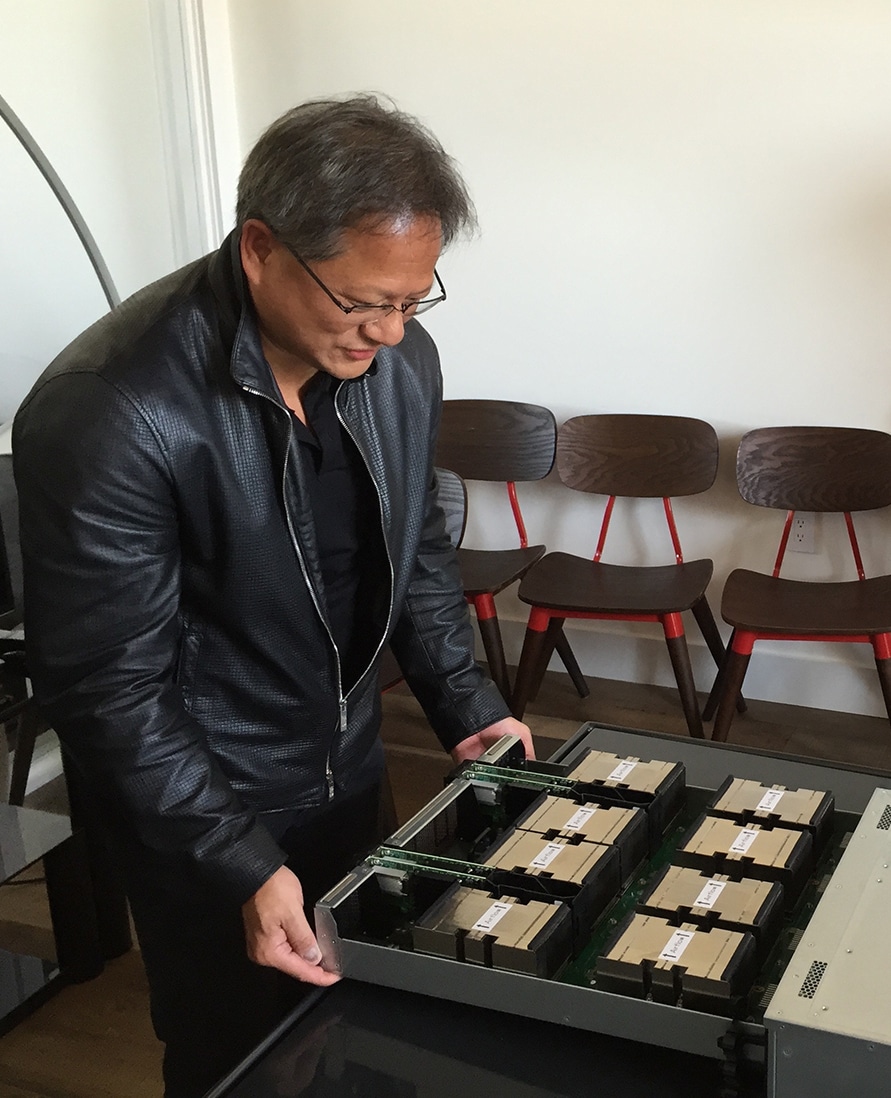
 Photo: NVIDIA
Photograph © NVIDIA. Original ↗
The first NVIDIA DGX-1, inscribed to OpenAI
The machine Jensen Huang signed and carried into OpenAI's office in August 2016. It has never been sold, nobody has documented where it is, and every NVIDIA hand-delivery since has quoted it.
- Maker
- NVIDIA
- Year
- 2016
- Category
- AI Hardware
- Associated with
- Jensen HuangElon Musk
No public price
Not for sale · None (unit donated to OpenAI in 2016)
Relic Score
How we scoreThe house scale's own example of a defining artefact, documented by contemporary press and by NVIDIA's later retellings. It has never been offered and its location is undocumented.
The three questions we ask of every object
- Why is it rare?
- It is a single object: the unit Jensen Huang inscribed as 'the world's first DGX-1' and carried to OpenAI in August 2016. It has never been sold and its whereabouts are undocumented.
- What story does it tell?
- The supplier of the era's computing power handing its first purpose-built deep learning system to OpenAI, with Elon Musk in the photograph. NVIDIA restaged the delivery in 2024 and 2025.
- Why would someone want it in 2050?
- Because it was physically present at a moment its own maker keeps quoting. If one machine comes to stand for the start of the AI boom, this is the likeliest, provided its location and custody are ever documented.
In history
The record
DocumentedNVIDIA announced the DGX-1 at its GTC conference on 5 April 2016 as 'the world's first deep learning supercomputer': eight Tesla P100 GPUs with 16GB each in a 3U chassis, up to 170 teraflops at half precision, a 7TB SSD cache and a power draw of 3,200W. General availability in the United States was planned for June 2016. TOP500 and Fortune gave the list price as $129,000.
In August 2016 NVIDIA co-founder Jensen Huang carried the first unit to OpenAI's office in San Francisco. Fortune reported on 15 August 2016 that the delivery had taken place 'last week' and that NVIDIA described it as a donation. Huang wrote on the chassis in marker: 'To Elon and the OpenAI Team! To the future of computing and humanity. I present you the world's first DGX-1!' The press photograph shows Huang with Elon Musk, then an OpenAI co-founder, beside the machine, and Ilya Sutskever was quoted calling it 'a huge advance'.
Huang has repeated the gesture twice. In April 2024 he delivered the first DGX H200 to OpenAI, dedicated 'to advance AI, computing, and humanity' according to Greg Brockman's post, and in October 2025 he handed a DGX Spark to Sam Altman. NVIDIA's own account of the 2025 deliveries recalls the 2016 one, 'nearly a decade' earlier.
We found no public record of a sale, a loan or a museum accession of the inscribed unit, and none of the sources we read says where it is today.
Why it matters
Editorial viewMost hardware becomes historic by accident. This machine was handed over as a historic object, with an inscription, a photographer and a founder on each side of it. What it records is the supplier of the era's computing power giving its first purpose-built deep learning system to OpenAI, with Elon Musk in the frame.
The best evidence of its standing is NVIDIA's own behaviour. The company restaged the delivery in 2024 and again in 2025, and its account of the DGX Spark launch points back to 2016. An object that its maker keeps quoting has already become a reference point.
Its limit is simple. It is one object, in corporate hands, with no documented location. Everything an outsider can say about it rests on a press photograph and a handful of reports from August 2016.
Rarity
DocumentedA single object: the unit Huang inscribed as 'the world's first DGX-1', as reported by Fortune and recalled by NVIDIA. NVIDIA has not published how many DGX-1 systems were built in total.
Classification
- Founder Signed
EvidenceInscribed and signed in marker by Jensen Huang at the August 2016 delivery, per Fortune and the press photograph. No third-party authentication exists or has been needed.
- History Used
EvidenceThe unit hand-delivered to OpenAI in San Francisco in August 2016, per Fortune, TOP500 and NVIDIA's own 2025 account.
- First Edition
EvidenceFirst generation of NVIDIA's DGX systems, announced on 5 April 2016 per the launch press release.
What to look for
- 01The inscription itself, matching the August 2016 press photograph word for word. It is the only thing that separates this unit from every other DGX-1.
- 02A paper trail from OpenAI or NVIDIA. If the unit ever surfaced, a corporate release document would matter more than any dealer's description.
- 03For an ordinary DGX-1: the original Tesla P100 configuration with its 2016 purchase paperwork. NVIDIA announced Volta-based DGX-1 systems in May 2017, so a later or upgraded system is a different object.
- 04Scepticism towards any DGX-1 described as 'early' or 'from OpenAI' without documents. Total production is unpublished, so there is no register to check a serial number against.
Will the first DGX-1 ever come to market, and what is the nearest thing a collector can own?
What follows is Future Relics’ editorial opinion. It is an argument about cultural significance, not a price forecast. We may be wrong, and we keep our old theses online when we are.
Probably not, and that is the reason to write about it. This is the reference object for AI hardware collecting: every later signed card and hand-delivered system is measured against it. Understanding why it is out of reach tells a collector what to look for elsewhere.
The claim is that it is this era's founding machine, with better paperwork than founding machines usually have. It is a single unit, the first of its kind, inscribed by its maker's co-founder in front of a camera and given to OpenAI. Most such objects are identified decades later by registries and experts. This one was labelled on the day.
The objection is that none of this makes it a collectible. It was given to a company, and companies keep such things, lose them or scrap them. We found no record of a sale, a loan or a museum accession, and no source says where it is. A relic nobody can locate is a story, and it may stay one. There is a quieter objection too: its fame rests on what OpenAI later became and on NVIDIA's retelling. The object did not make that history. It was present at the start of it.
So the thesis is really about relatives. The closest are the other first units Huang delivered in person, the DGX H200 of April 2024 and the DGX Sparks of October 2025, none of which is known to have changed hands. One step further out are objects he signed that did reach auction: an RTX Pro 6000 at $57,450 and an RTX 5090 Founders Edition at $12,501, both at RR Auction in 2026. Furthest out is an ordinary DGX-1, which shares the model number and nothing else. If the first unit does reappear, a museum is a likelier destination than a saleroom, as it was for IBM's Watson.
Precedents
- IBM Watson (2011): one of the 90 servers behind the Jeopardy! system was donated by IBM to the Computer History Museum in November 2014. The route from corporate milestone to museum is documented. A route to private hands is not.
- Apple-1 (1976): 200 boards, 94 verified or almost-verified survivors on the Apple-1 Registry, and a record of $2,750,000 at RR Auction in January 2026. Founding machines do trade, but these were sold to individuals from the start.
- Jensen Huang signed hardware (2026): $57,450 for a twice-signed RTX Pro 6000 and $12,501 for a twice-signed RTX 5090 Founders Edition, both at RR Auction including buyer's premium. These are the only priced relatives, and they are signed retail cards, not first units.
What would prove us wrong
- It may no longer exist in its 2016 state. Nothing in the sources says whether it was run, upgraded, stored or scrapped.
- It may go straight to an institution. That would settle its status and remove it from the market for good.
- Title is undocumented. NVIDIA described the machine as a donation to OpenAI, the inscription names Elon Musk, and no source says who holds it today.
- The obtainable relatives carry little of its meaning. An ordinary DGX-1 is an obsolete rack server, and a signed graphics card is an autograph. Buying either as a stand-in for the first unit is buying the caption without the picture.
How to acquire
Not obtainable. No sale, loan or museum accession of the inscribed unit is on record, and its current location is not documented in any source we read. Ordinary DGX-1 systems were sold by NVIDIA and system integrators from 2016 at a reported list price of $129,000; we did not verify used-market availability or prices.
How to preserve
A DGX-1 is a 3U rack server drawing 3,200W, per NVIDIA's launch release, so running one needs data-centre-class power and cooling. We collected no sourced information on how its components age. As general advice for a signed chassis, not a sourced finding: marker ink on metal is vulnerable to abrasion, solvents and light, so an inscribed surface should not be cleaned or handled.
Where it stands
- None (unit donated to OpenAI in 2016) ↗
Unique inscribed unit, described by NVIDIA as a donation to OpenAI. No sale has ever been reported.
Not for saleChecked 24 Nov 2026
Asking prices and stock are as observed on the date shown and change without notice. Future Relics does not sell these objects and currently earns no commission on these links.
What we could not confirm
The exact delivery day is not stated: Fortune said 'last week' on 15 August 2016, and a thank-you tweet from Musk dated 9 August was seen only in search results. The sources show Musk in the photograph but do not list everyone present. NVIDIA and Fortune call the machine a donation; TOP500 says whether OpenAI paid anything is not stated. The inscription is quoted from summarised press reports and should be checked against the photograph. The unit's current whereabouts are unknown.
Sources
- [1]NVIDIA press release: NVIDIA launches world's first deep learning supercomputer (5 Apr 2016) · nvidianews.nvidia.com ↗
- [2]Fortune: Elon Musk's OpenAI gets NVIDIA supercomputer (15 Aug 2016) · fortune.com ↗
- [3]TOP500: NVIDIA delivers DGX-1 'supercomputer in a box' to OpenAI (15 Aug 2016) · top500.org ↗
- [4]Fortune: Jensen Huang on delivering the first AI supercomputer (22 Feb 2024) · fortune.com ↗
- [5]Analytics India Magazine: Jensen Huang personally delivers first NVIDIA DGX H200 to OpenAI (25 Apr 2024) · analyticsindiamag.com ↗
- [6]NVIDIA Blog: DGX Spark early deliveries, recalling the 2016 DGX-1 delivery (Oct 2025) · blogs.nvidia.com ↗
- [7]NVIDIA press release: new Volta-based DGX systems (10 May 2017) · nvidianews.nvidia.com ↗
- [8]Computer History Museum press release: IBM Watson server donation (20 Nov 2014) · computerhistory.org ↗
- [9]Apple-1 Registry: market and auction results · apple1registry.com ↗
- [10]RR Auction, lot 4200: Jensen Huang twice-signed NVIDIA RTX Pro 6000 · rrauction.com ↗
- [11]RR Auction, lot 6160: Jensen Huang twice-signed RTX 5090 Founders Edition · rrauction.com ↗
Record opened 24 Nov 2026 · Last verified 24 Nov 2026
In the Journal
- What is the tech equivalent of Michael Jordan's $10 million jersey?
In 2022 a basketball shirt sold for $10.091 million, not because Jordan wore it, but because of the night he wore it. Technology has objects like that. Almost nobody is looking for them.
- Where is the first NVIDIA supercomputer ever delivered to OpenAI?
In August 2016 Jensen Huang carried a machine into a small San Francisco lab and wrote a dedication on the lid. It may be the most important object of the AI era. Nobody will say where it is.
More from NVIDIA
Company file →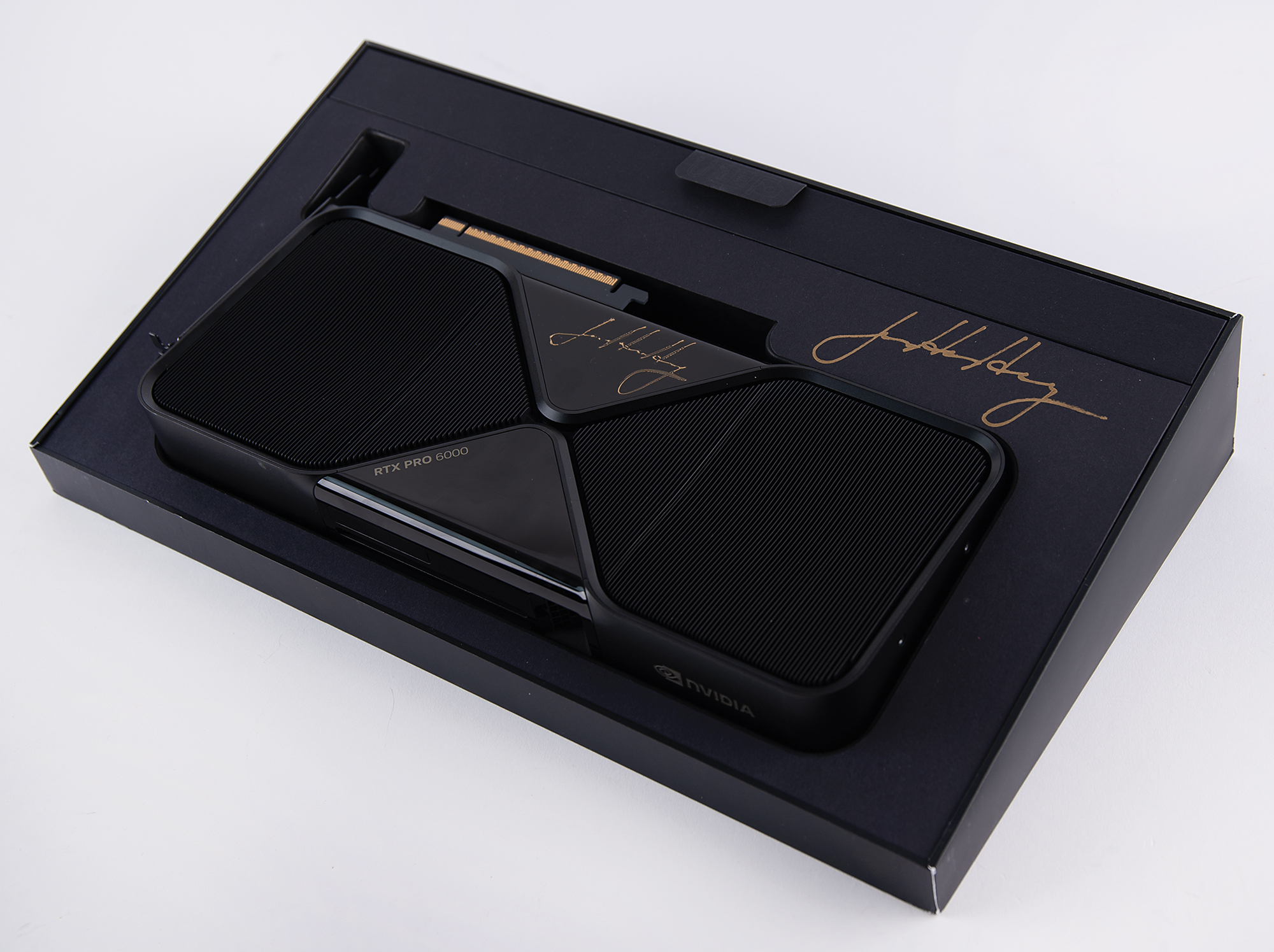 Photo: RR Auction
Jensen Huang twice-signed RTX Pro 6000 Blackwell
NVIDIA · 2026$57,450
Incl. premium · RR Auction · 20 Aug 2026
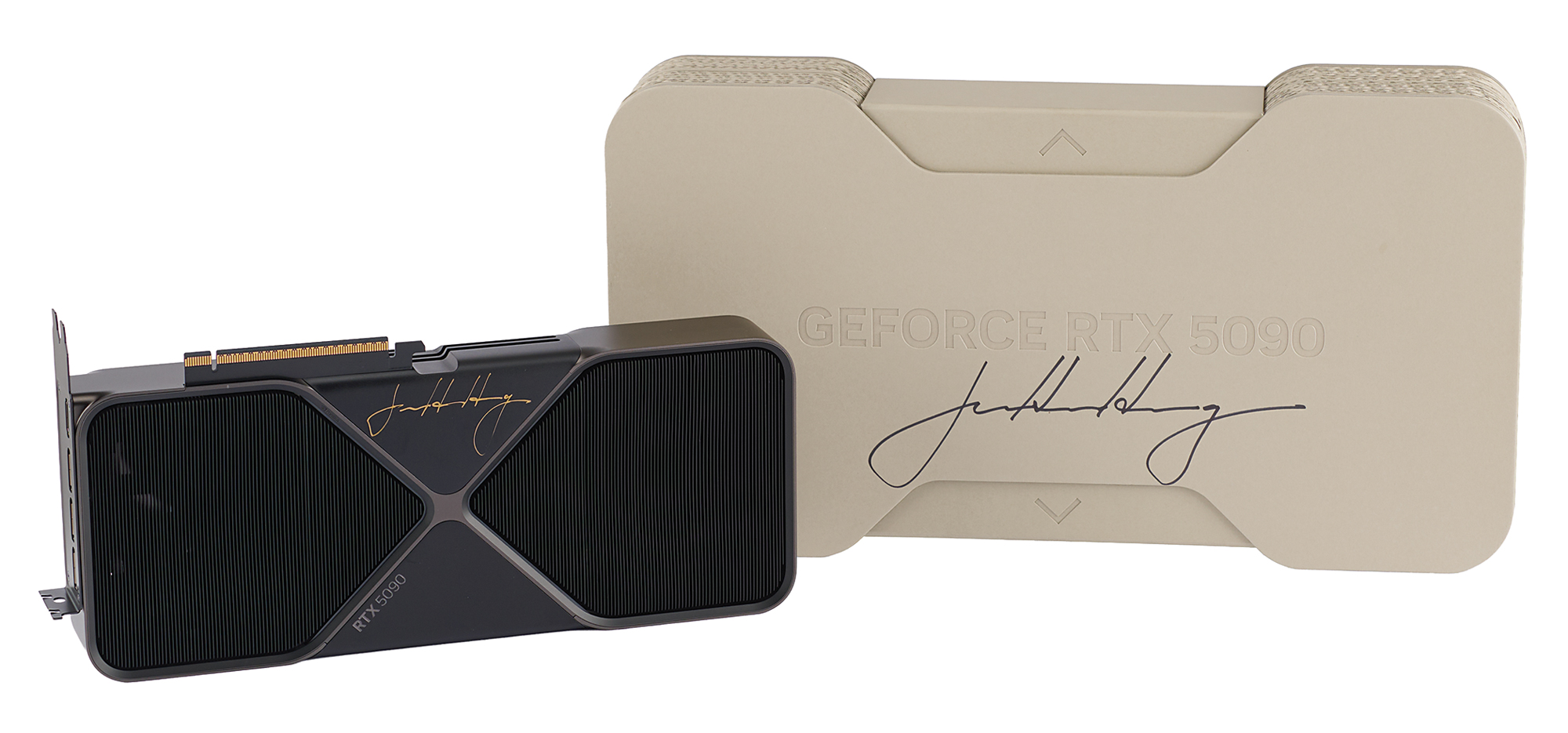 Photo: RR Auction
Jensen Huang signed GeForce graphics cards
NVIDIA$12,501
Incl. premium · RR Auction · 29 Jan 2026
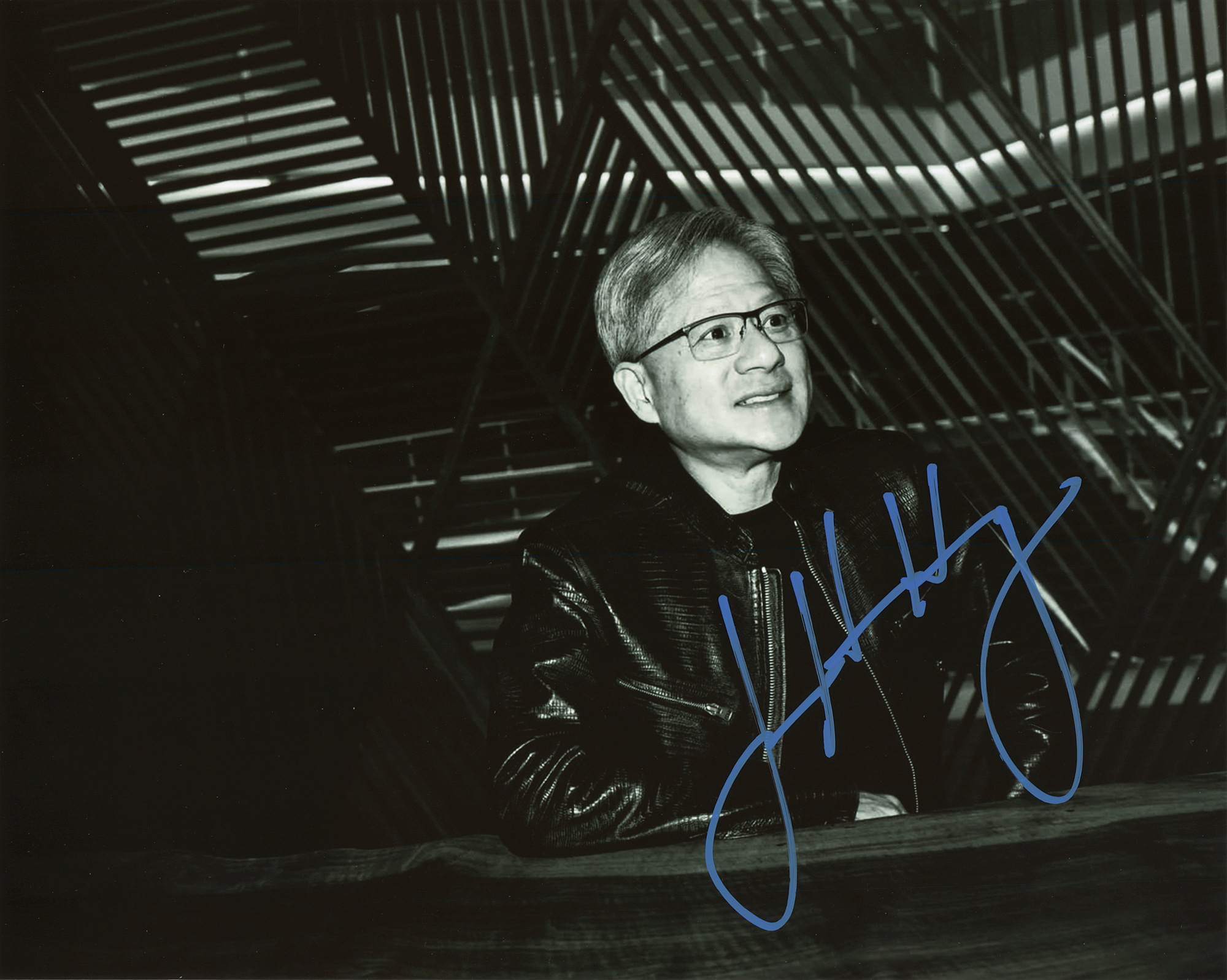 Photo: RR Auction
Jensen Huang signed photograph
NVIDIA$1,169
Incl. premium · RR Auction · 20 Aug 2026
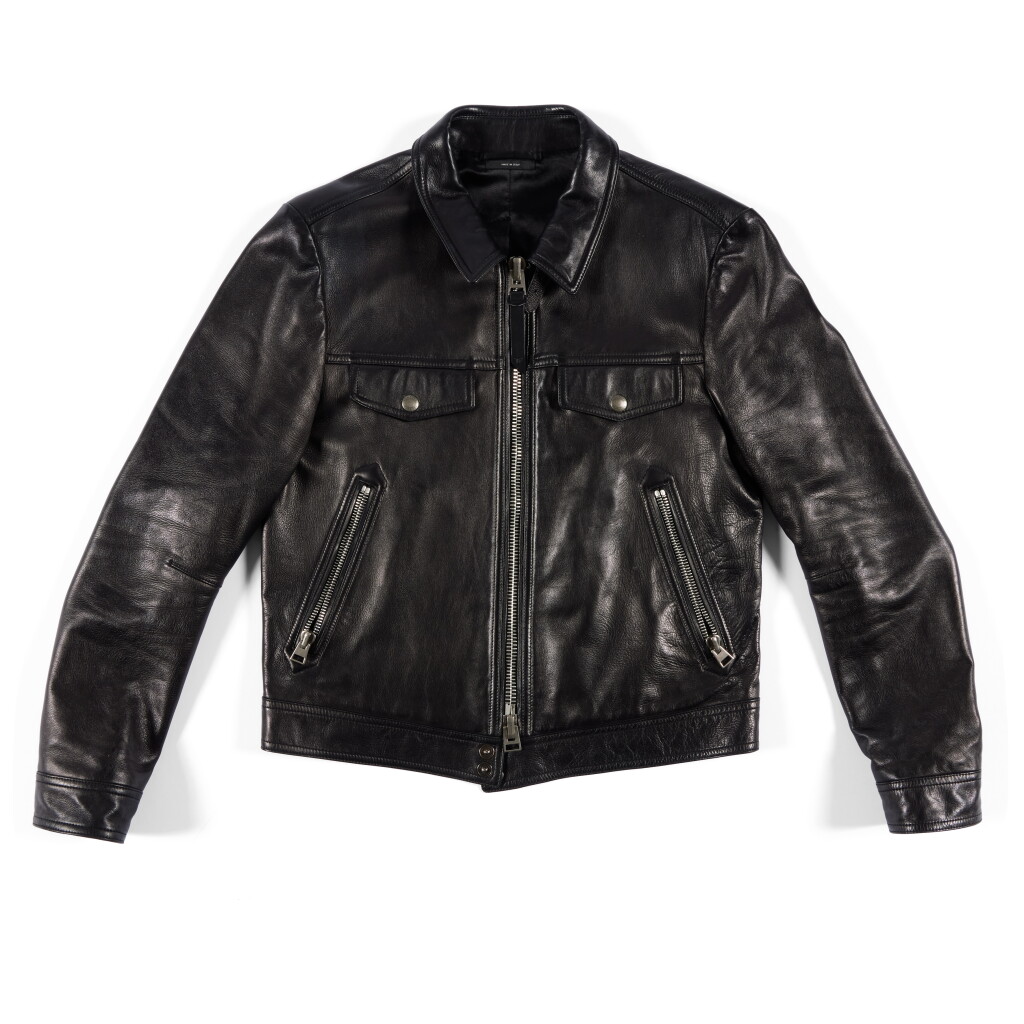 Photo: Sotheby's
Jensen Huang worn and signed Tom Ford leather jacket
Tom Ford · 2023$960,000
Reported · Sotheby's · 17 Jul 2026