 Photo: TheStriker / Wikimedia Commons, licence CC BY-SA 4.0
Photograph © TheStriker / Wikimedia Commons, licence CC BY-SA 4.0. Original ↗
NVIDIA GeForce GTX 580, the AlexNet GPU
AlexNet, the network that won ImageNet in 2012, was trained on two of these gaming cards. The two cards that did it have never been identified, and that is the whole problem.
- Maker
- NVIDIA
- Year
- 2010
- Category
- AI Hardware
No public price
Value unproven
Relic Score
How we scoreThe history score is for the model's role in a landmark result. No individual card has any documented link to it, and none has sold as a collectible.
The three questions we ask of every object
- Why is it rare?
- It is not. Every surviving GTX 580 is simply an example of the model, and production was never published. The two 3GB cards that trained AlexNet would rank at the very top, but they have never been identified.
- What story does it tell?
- AlexNet, which won ImageNet in 2012, was trained on two of these consumer gaming cards over five to six days. The deep learning era began on hardware sold for higher frame rates.
- Why would someone want it in 2050?
- Probably few will want an ordinary one: it is the same model, not the same object. Only documented provenance to the machine Alex Krizhevsky used would change that.
In history
The record
DocumentedNVIDIA announced the GeForce GTX 580 on 9 November 2010 at a suggested United States price of $499, with partner cards shipping the same day. The launch card had 1.5GB of GDDR5 memory and all 512 CUDA cores of the Fermi design enabled.
AlexNet, the neural network that won the 2012 ImageNet competition, was trained on two GTX 580 cards with 3GB each. According to Wikipedia's summary of the original paper by Alex Krizhevsky, Ilya Sutskever and Geoffrey Hinton, the model was split across the two GPUs because it did not fit in one card's memory, and training ran for 90 epochs over five to six days.
On 20 March 2025 the Computer History Museum, after five years of work with Google, released the original 2012 AlexNet source code for public access and long-term preservation. Its release says Krizhevsky trained the network 'on a computer with two NVIDIA graphics cards'. The code is hosted on the museum's GitHub under a BSD-2 licence.
The museum preserved the code, not the hardware. We found no museum holding of the two cards Krizhevsky used and no source that identifies them individually.
Why it matters
Editorial viewIf the deep learning era has a starting gun, it is AlexNet, and AlexNet ran on consumer hardware. Not a supercomputer or a research accelerator: two graphics cards sold to people who wanted higher frame rates. NVIDIA's own history of the GeForce 256 ends its story at this result.
It also shows how poorly the field has documented its own beginnings. The Computer History Museum spent five years securing the source code. Nobody appears to have kept track of the cards.
The limit is plain. A GTX 580 bought today is the same model, not the same object. And the launch card had 1.5GB of memory; the AlexNet cards were the 3GB variant, whose launch date and price we could not find.
Rarity
Not documentedProduction numbers were never published. No individually identified 'AlexNet cards' are documented in any source we read, so every surviving GTX 580 is simply an example of the model.
What to look for
- 01The 3GB version. The launch GTX 580 had 1.5GB; AlexNet was trained on two 3GB cards.
- 02A retail box, receipt or anything else that dates the card to the years before the 2012 result.
- 03A matched pair, if the aim is to show how the network was actually trained: split across two cards because it did not fit in one.
- 04Documents, not adjectives. No card is known to come from Krizhevsky's machine, and a listing that implies otherwise needs proof from someone who was there.
Is an ordinary GTX 580 a relic of AlexNet, or just an old graphics card?
What follows is Future Relics’ editorial opinion. It is an argument about cultural significance, not a price forecast. We may be wrong, and we keep our old theses online when we are.
Mostly the second, and the gap between the two is where the interest lies.
The claim would run like this. The GTX 580 3GB is the cheapest way to hold the hardware of a turning point. The event is as well attested as any in AI: a museum has archived the code, and the paper records the two cards and the five to six days. The model was a mass-market product discontinued long ago, so the supply can only shrink. As a type specimen, a boxed 3GB card belongs in any collection that tries to tell the story of AI hardware in objects.
The objection is that a type specimen is all it can be. Nothing connects any surviving card to Krizhevsky's machine. No serial numbers were published, no museum holds the originals, and we found no individually identified 'AlexNet cards' anywhere. This was a retail card sold through NVIDIA's partners at $499. A seller who writes 'the AlexNet GPU' in a listing is describing a model number.
So the thesis narrows twice. For an ordinary card: the 3GB version, not the 1.5GB launch card, complete in its retail box, bought as a reference object and not as a rarity. For the real prize: the two original cards, if they survive and if someone close to the work can document them. Those would be history-making objects in the strict sense. We have no evidence that they still exist, that anyone has looked for them, or that they would ever be offered. Until one of those things changes, the honest description is an old graphics card with a very good story about two of its siblings.
Precedents
- AlexNet source code (2012): released by the Computer History Museum on 20 March 2025 after five years of work with Google. The institution preserved the software. The hardware was not part of it.
- IBM Watson (2011): one of the 90 servers of the Jeopardy! system entered the Computer History Museum in November 2014. A specific machine tied to a specific event is what a museum collected; a same-model server would not have been.
- Original iPhone, 4GB (2007): about 6.1 million first-generation iPhones were sold, and a factory-sealed 4GB example made $190,372.80 at LCG Auctions in July 2023. In mass-produced hardware, interest has gone to exceptional state and paperwork, not to the model as such.
What would prove us wrong
- No provenance is possible for ordinary cards. Every GTX 580 is equally 'the AlexNet GPU', which means none is.
- The wrong variant. The launch card had 1.5GB; AlexNet used 3GB cards. Listings rarely make the distinction.
- The original pair may surface and go to a museum, leaving same-model cards as souvenirs of something on public display. Or they may have been thrown away years ago.
- The details collectors repeat are the weakest ones. The GPU model and training time reach us through Wikipedia's summary of the paper, and the story that the machine sat in Krizhevsky's bedroom is uncited there and absent from the museum's release.
- No market evidence. We found no recorded sale of a GTX 580 as a collectible.
How to acquire
Discontinued and available second-hand only. We collected no verified sale prices. Any card offered as 'the AlexNet GPU' is simply the same model unless documented otherwise.
How to preserve
We collected no sourced preservation information for this card. As general advice, not a sourced finding: store it in an anti-static bag away from heat and humidity, keep the retail box and accessories with it, and expect the thermal paste and fan on a card of this age to need attention before it is run.
What we could not confirm
The GPU model and training time come from Wikipedia's summary of the original paper, not from the paper itself. The often-repeated detail that the machine sat in Krizhevsky's bedroom at his parents' house is uncited on Wikipedia and absent from the museum's release: treat it as unverified. The launch date and price of the 3GB variant were not found.
Sources
- [1]PC Watch (Impress): GeForce GTX 580 announced at $499 (Nov 2010) · pc.watch.impress.co.jp ↗
- [2]Computer History Museum press release: CHM makes AlexNet source code available to the public (20 Mar 2025) · computerhistory.org ↗
- [3]Wikipedia: AlexNet (summarising Krizhevsky, Sutskever and Hinton) · en.wikipedia.org ↗
- [4]NVIDIA Blog: 25 years of the GeForce 256 (11 Oct 2024) · blogs.nvidia.com ↗
- [5]Computer History Museum press release: IBM Watson server donation (20 Nov 2014) · computerhistory.org ↗
- [6]MacRumors: Rare 4GB original iPhone sells for record $190,000 (17 Jul 2023) · macrumors.com ↗
- [7]Wikipedia: iPhone (1st generation) · en.wikipedia.org ↗
Record opened 24 Nov 2026 · Last verified 24 Nov 2026
More from NVIDIA
Company file →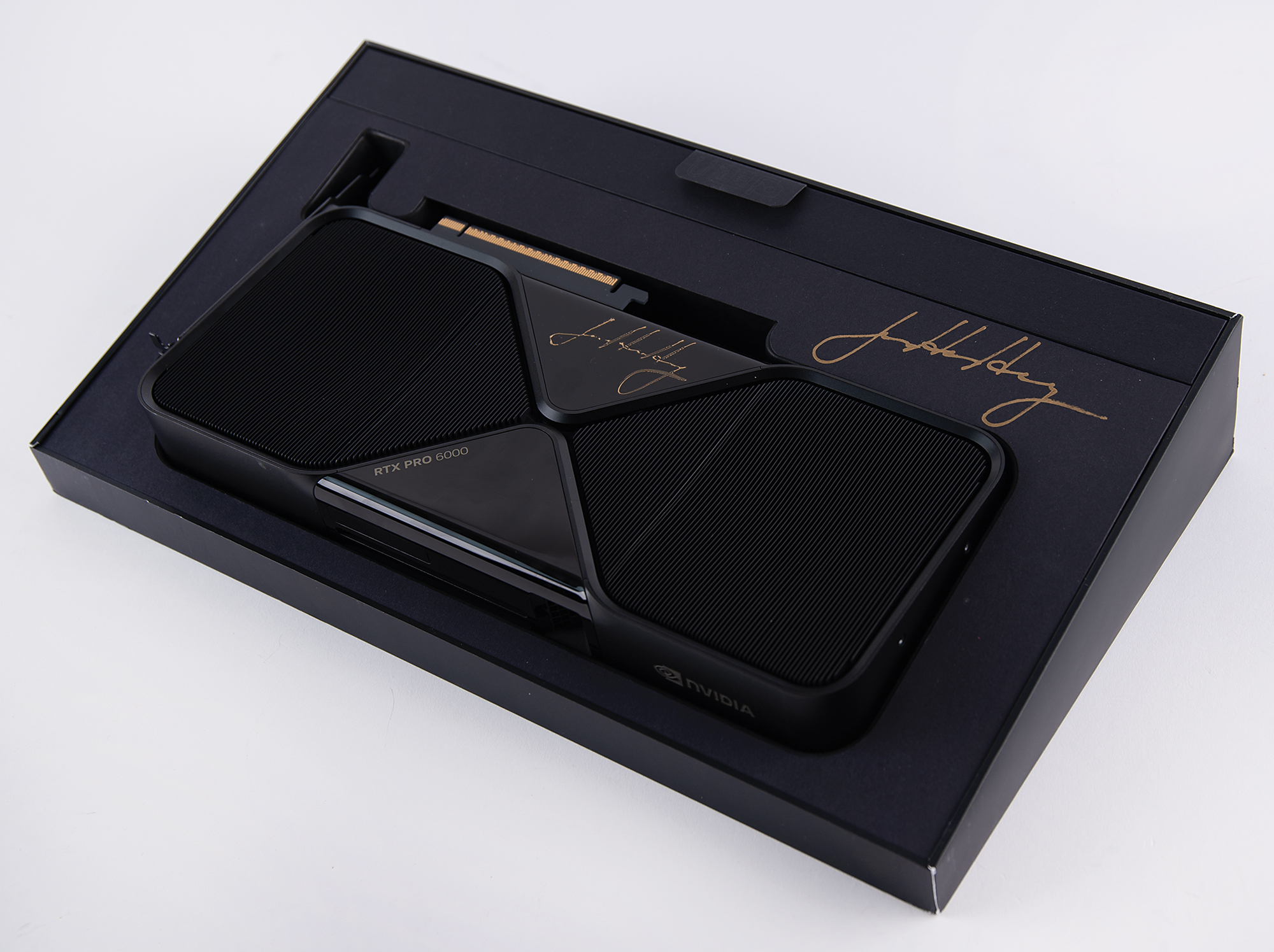 Photo: RR Auction
Jensen Huang twice-signed RTX Pro 6000 Blackwell
NVIDIA · 2026$57,450
Incl. premium · RR Auction · 20 Aug 2026
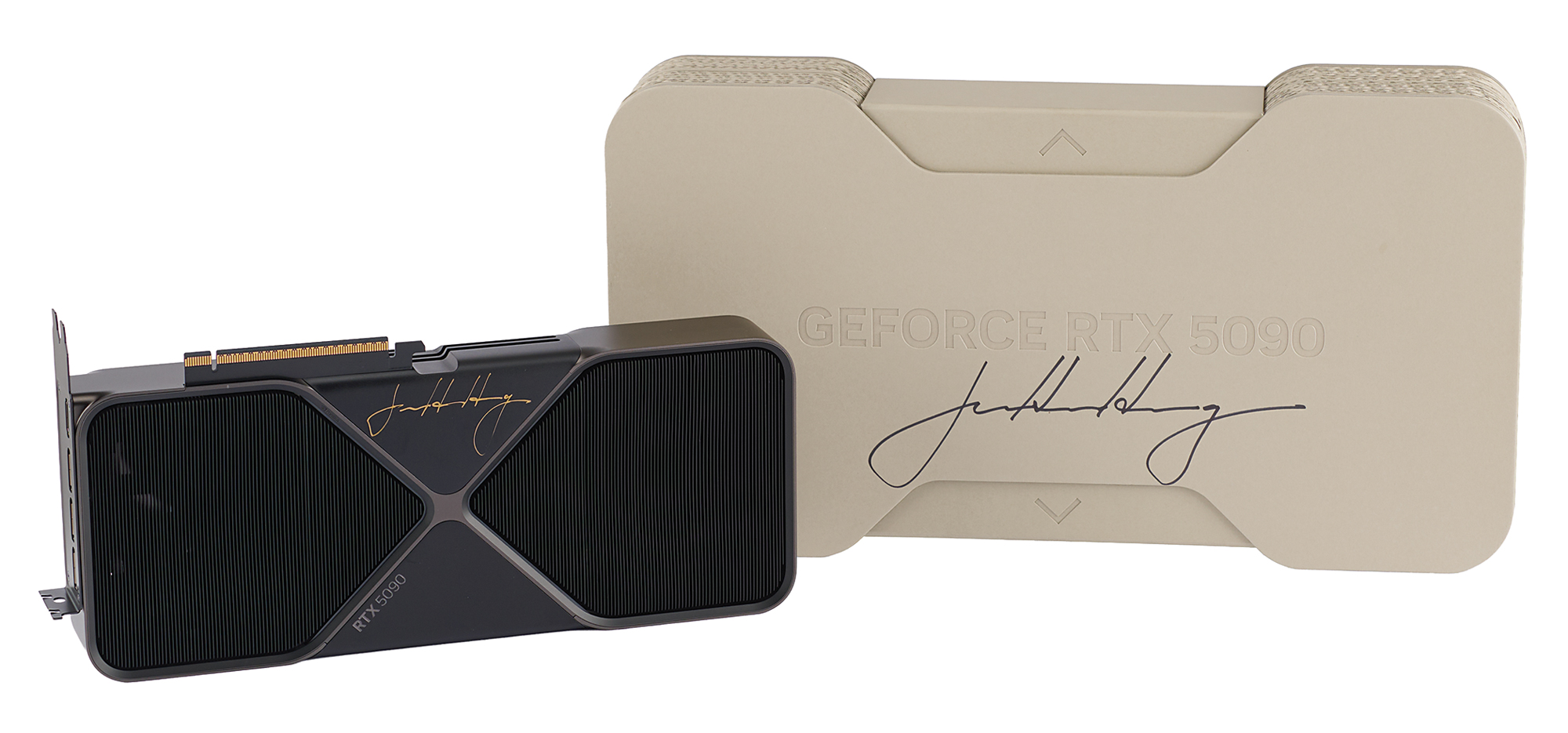 Photo: RR Auction
Jensen Huang signed GeForce graphics cards
NVIDIA$12,501
Incl. premium · RR Auction · 29 Jan 2026
 Photo: RR Auction
Jensen Huang signed photograph
NVIDIA$1,169
Incl. premium · RR Auction · 20 Aug 2026
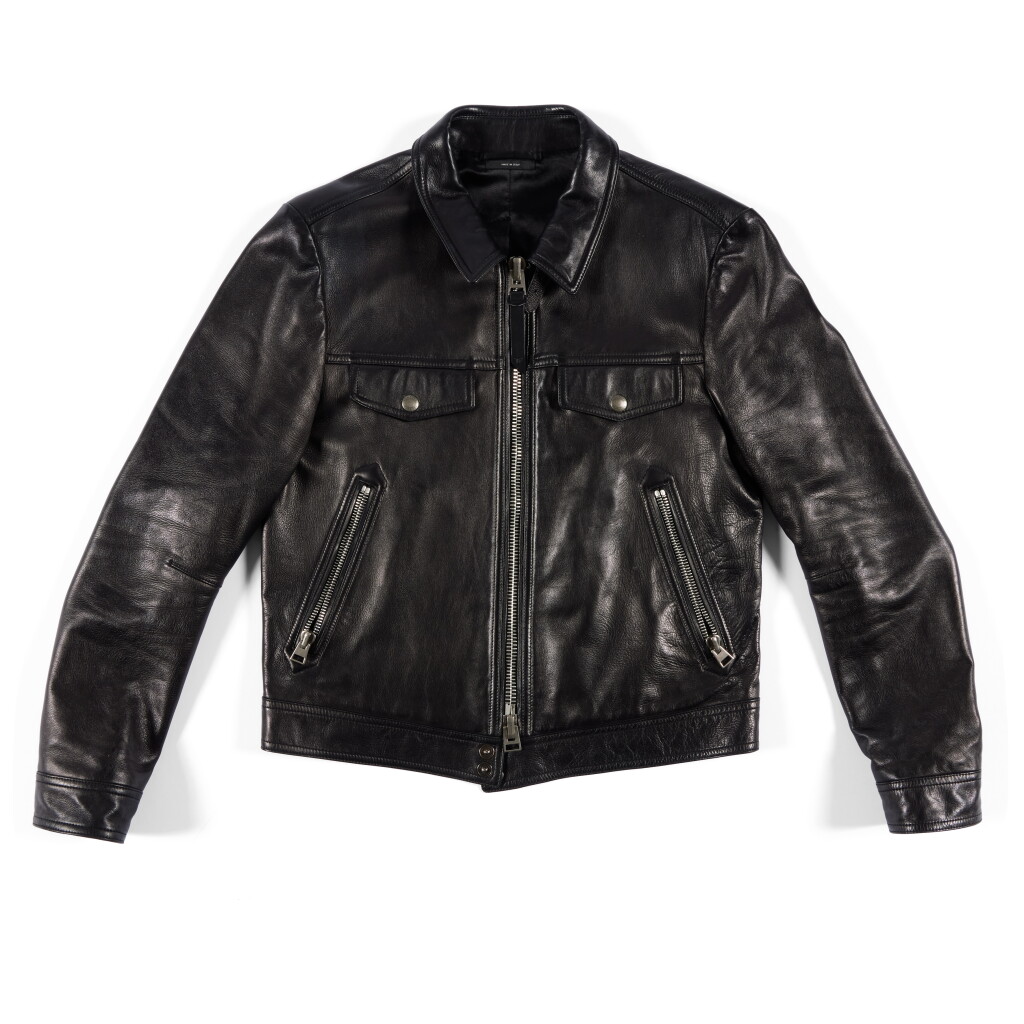 Photo: Sotheby's
Jensen Huang worn and signed Tom Ford leather jacket
Tom Ford · 2023$960,000
Reported · Sotheby's · 17 Jul 2026