 Photo: RR Auction
Photograph © RR Auction. Original ↗
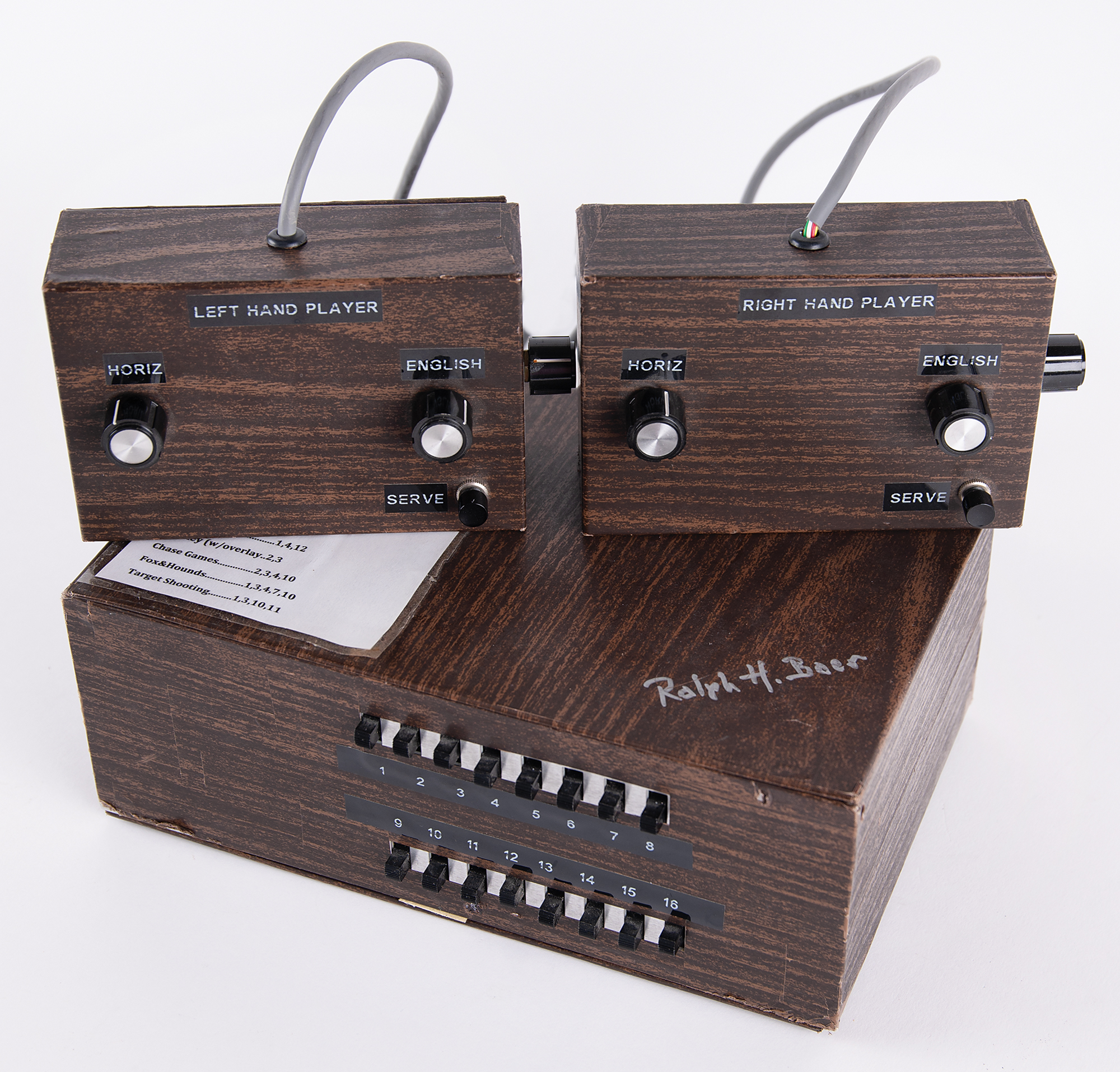
Ralph Baer signed 'Brown Box' demonstration console, 2010
Not one of the 1960s prototypes, but a Brown Box that Ralph Baer built himself in 2010 for a televised demonstration, then signed and gave away. It sold for $124,781 in 2026.
- Maker
- Sanders Associates
- Year
- 2010
- Category
- Tech History
- Associated with
- Ralph Baer
$124,781
Incl. premium · RR Auction · 20 Aug 2026
Relic Score
How we scoreBuilt and signed by the inventor and fully catalogued, but a 2010 demonstration unit with a single sale.
The three questions we ask of every object
- Why is it rare?
- RR Auction found no other documented late-life Brown Box demonstration console built by Baer himself. The original 1960s prototypes are held by the Smithsonian.
- What story does it tell?
- Ralph Baer's Brown Box led to the Magnavox Odyssey. In 2010 the inventor built this one himself, played Ping-Pong on it on stage for a PBS special, and gave it away.
- Why would someone want it in 2050?
- It is not an original prototype, and buyers should be clear about that. It is an object the inventor built and used, which will matter to those collecting the history of video games.
The record
DocumentedA wood-grain 'Brown Box' video game demonstration console, custom-built by Ralph H. Baer in 2010 for the PBS special Video Games Live and signed by him in silver ink. Baer added a modern coaxial video output so that it would work with contemporary displays.
According to the producer Tommy Tallarico, Baer used it in an onstage Ping-Pong demonstration and then gave it to him.
The original Brown Box prototypes were developed at Sanders Associates from 1966 and led to the Magnavox Odyssey. The Smithsonian holds the original development units.
It was lot 4210 of RR Auction's Steve Jobs & the Computer Revolution: The Apple 50th Anniversary Auction, Part Two, which closed on 20 August 2026. Estimated at $100,000+, it sold for $124,781 including buyer's premium.
Why it matters
Editorial viewThe originals are in the Smithsonian, which puts them beyond any collector. That leaves the question of what a later Brown Box is worth when the man who built it is the man who invented it. This is not a replica by an admirer. It is the inventor's own restatement of his design, 44 years on, made to be shown working in front of an audience.
The market's answer was $124,781, more than a working Lisa-1 or the 'Stealth iPod' prototype made in the same sale. For an object of video game history made in 2010, that is a serious price.
It should still be described exactly. It dates from 2010, it has a modern video output, and the story of its use and gift comes from the person who received it.
Rarity
DocumentedRR Auction states that its research found no other documented late-life Brown Box demonstration console personally built by Baer.
What to look for
- 01Baer's silver-ink signature on the console.
- 02The coaxial video output Baer added, which marks this as the 2010 build.
- 03Tommy Tallarico's account of the gift in writing, and footage of the *Video Games Live* demonstration showing this console.
- 04Any description that calls it an original prototype. It is not one; the 1960s units are in the Smithsonian.
Sales history
Sourced| 20 Aug 2026 | RR AuctionRalph H. Baer signed and custom-built 'Brown Box' demonstration console for the PBS concert special Video Games LiveLot 4210, Auction #748. The lot page states the price includes buyer's premium. | $124,781Price realisedEstimate $100,000+ | Source ↗ |
A past result for one example is not a valuation for another. Condition, provenance and timing differ.
What we could not confirm
This is a 2010 demonstration unit, not one of the 1960s prototypes. The account of its use on stage and of the gift is Tommy Tallarico's, as quoted by RR Auction. Sanders Associates is listed as the maker because the Brown Box was developed there; this unit was built by Baer personally.
Sources
- [1]RR Auction, lot 4210: Ralph H. Baer signed and custom-built 'Brown Box' demonstration console (20 Aug 2026) · rrauction.com ↗
- [2]RR Auction: Jensen Huang-signed NVIDIA graphics card sells for $57,450 (3 Sep 2026) · content.rrauction.com ↗
Record opened 24 Nov 2026 · Last verified 24 Nov 2026
In the Journal
- What is the tech equivalent of Michael Jordan's $10 million jersey?
In 2022 a basketball shirt sold for $10.091 million, not because Jordan wore it, but because of the night he wore it. Technology has objects like that. Almost nobody is looking for them.